Tag Archives: Family Living Center

The Heritage of the Nauvoo Niddy Noddy

??????????

Blog #84

By Kevin V. Hunt

The Nauvoo Niddy Noddy … now there is an attention grabber.  Gotcha!

In this case, the Niddy Noddy is actually about food.  Everyone I have ever known has loved food – good food – and eating.  And of course that is, has been, and always will be the case in Nauvoo.  So let’s explore the tradition and heritage of the Nauvoo Niddy Noddy.

INTRODUCING THE NIDDY NODDY

Recently my wife has been organizing and cleaning the front bedroom of our home.  She calls this room her “craft room” – but it also houses the guest bed for incoming guest couples.  (I also have my room … it is my “Office/Scouting and History Museum”.)  Lou is preparing for company coming soon.

In her cleaning, Lou unearthed a great find.  A worn, well-used, and vintage cookbook:
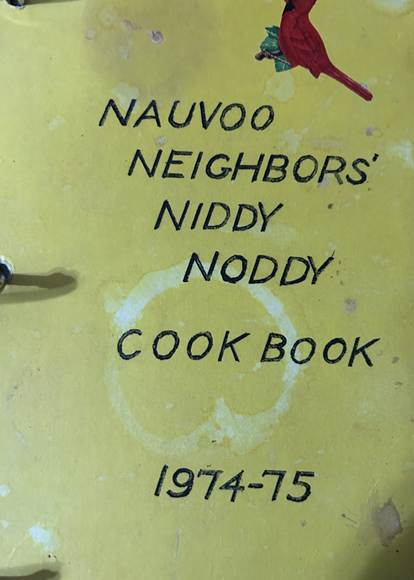
Wow!  Such a fun history find.   I opened the cover and began to read.

The name of the cookbook first caught my attention.  It was: “Nauvoo Neighbors’ Niddy Noddy Cookbook – 1975”  How’s that for a name?  Are you kidding me?  That was the year I was there as a “young missionary”.  I dug into the book immediately and realized that I knew every single “older sister” who contributed to the book.  And I realized that I had tasted many of the recipes in our monthly pot-luck dinners back then in Nauvoo.  And with margin notes of “good” or “very good”, Etc. in my writing, I realized that sometime in my past, I had made great use of this book – and had prepared many items from it.

But “Niddy Noddy” … how did they come up with that one? Well, they didn’t keep me in suspense.  The introductory pages of the cook book had the answers.  First off, it introduced the group saying, “The Missionary Sisters of Nauvoo Restoration, Inc.,  met once a week during the winter months of 1974-1975.  “Nauvoo Neighbors” was chosen as the name of the group.  This was taken from an early Nauvoo publication.”  [That was the name of the Nauvoo newspaper back in the pioneer day.]

Having endured a Nauvoo winter – when nothing much was happening I can see how they had time and interest in getting together.  But those Sisters must have really been into it.  The book listed their “Nauvoo Neighbor Officers”.  Sister Neda H. Gyllenskog was President with counselors Phyllis L. Leishman and Alva W. Hardy.  Nellie Stevenson was shown as the “Crochet Chairman” and Jo Fairbanks was shown as the Cook Book Chairman with committee members Marian Hadley, Ethel Mathews, and Phyllis Leishman.  Those names bring back a lot of fond memories of great ladies I served with in Nauvoo.

Continuing from the intro  “… During the year a cook book was compiled of recipes contributed by the sisters.  It was named the “Niddy Noddy” Cook Book from a measuring devise used during the Nauvoo Period.”

So, how did they know about the Niddy Noddy?  That was long before Miss Google and all of her friends came along.  I am happy that I have the help of Google today for such occasions.  I decided to delve into it a bit deeper.

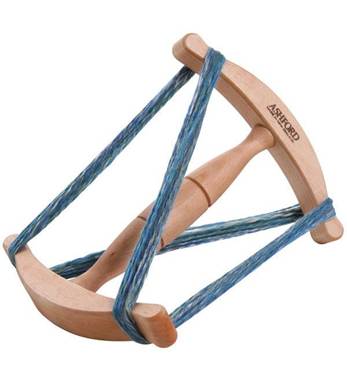
Miss Google revealed that the “Niddy Noddy” is “A traditional hand-spinning tool used to wind yarn from a bobbin into a skein (or hank) and to measure its length.  It consists of a central handle with crossbars at each end, often used in historical reenactments.”  I even found a photo of the instrument – and several options for purchasing them.  I guess they are still a thing in the fiber world.  Who knew?
The next page of the Niddy Noddy cookbook  detailed “Emergency Substitutions”.  (The original Nauvoo pioneer women were probably Queen of Substitutions.  They probably had to frequently substitute.)

Anyway … some good info:

1 cup sour milk or buttermilk — 1T lemon juice or vinegar – fill cup with sweet milk

1 cup fresh sweet milk – 12 cup evaporated milk plus 1/2 cup water

1 cup honey – ¾ cup sugar plus ¼ cup liquid

1 Tbsp. cornstarch – 2 Tbsp. Flour

1 cup catsup or chili sauce – 1 cup tomato sauce plus ½ cup sugar and 2 tbsp vinegar

1 cup brown sugar (firm) – 1 cup granulated sugar

1 cup butter or margarine – 1 cup shortening and ½ tsp salt (for baking)  [Nowadays with the price of shortening, we go the other direction … converting shortening to butter or margarine.  GTK … Good to know!)

On the next page was a “Recipe to Preserve a Husband”:

“Mix well together the following ingredients:

A full measure of honesty

To which add sincerity

Blend with dependability and trustworthiness

Spice generously with fun and laughter

Garnish with patience well sweetened with smiles

And flavored with cookies to taste.

Then wrap in a mantle of charity

Keep warm with a steady fire of devotion

Serve with peaches and cream

  • Ethel Mathews

THE NAUVOO HERITAGE OF IDA BLUM

When young in Nauvoo, I met Ida Blum.  She was kind of a hunched over little lady.  She was not a member of The Church of Jesus Christ of Latter-day Saints but she always came to our church meetings with a couple of her old lady friends.  One was a Mrs. McConkie.  (My mother-in-law knew these ladies well on her Nauvoo mission of 1979-1981.)

I thought that Ida Blum was ancient history when I met her.  Again, Google tells me that she would have been 86 when I knew her in 1975.  (And she died in 1980.)  “Ida Kuhn (a German name) was born September 2, 1889 in Nauvoo.”  She lived her entire life in Nauvoo.

I liked the modern artwork of the first recipe section of the book:
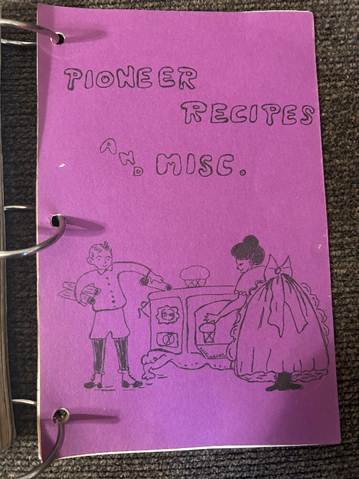
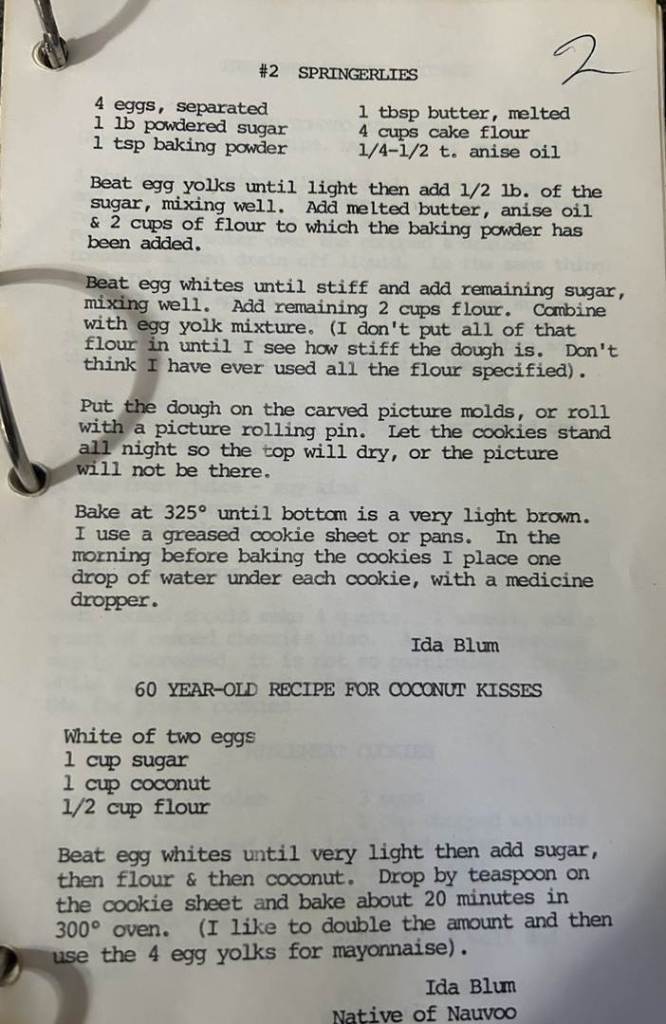
In this section, Ida introduced the first recipe of the book:  “This recipe has been in the Blum family for more than a century.  [So that would put it almost to the Nauvoo pioneer era.  The Germans came to Nauvoo after the departure of the “Mormons”.]  I have used it many times, then hartshorn was difficult to find in drug stores, so I commenced using the second recipe.”

She said that her original recipe for “Springerlies of Picture Cookies”  called for “two level teaspoons of hartshorn which had been powdered fine.  (One needs a hammer to do this for if the hartshorn is easy to crush it is useless.  Do not use more than two level teaspoons of the powder).”  I will leave it to your own imagination as to what “Hartshorn” might be – Kevin
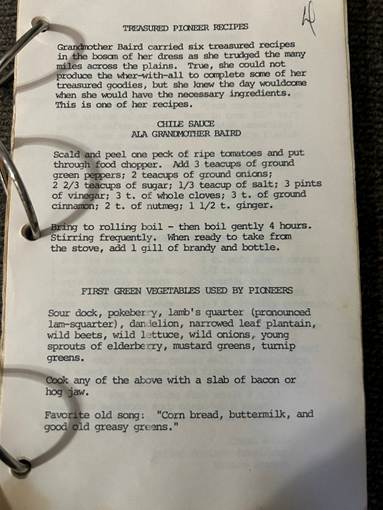
This one – not from Ida looked intriguing:
And one more note about Ida.  I wrote of her in a blog created around December of 2024 but … Sister Hunt and I drove through a very old Nauvoo cemetery.  (I am weird … I often get my jollies by driving through or walking and reading headstones in cemeteries!)  As we rounded one corner I was drawn to the headstone that said “Ida Blum”.  I had to get out to investigate.  “1889 – 1980”.  I said to my wife, “I knew that lady”.

BEGINNING OF A FAMILY TRADITION IN THE NIDDY NODDY

In the Niddy Noddy, I was particularly drawn to one recipe that I recognized.  And in the margin, I had back then added my own hand-written note that said, “Very Good”.

For many years, our family has enjoyed making and eating “Nauvoo Potatoes”.  They are now a part of every major holiday celebration and often many times in between.  It has become the family craving. 
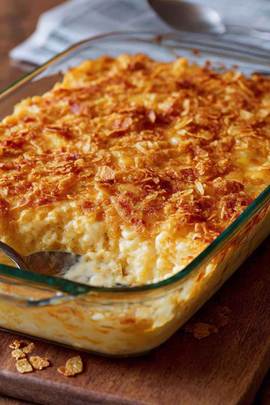
“Nauvoo Potatoes” … that is the only name that I have known them by.  I introduced this gourmet potato casserole to my parents and sibling family as I returned from my “young mission” in Nauvoo 1975 and I cooked them for Lou and our kids from the beginning of the Kevin and Lou family.   They (“potatoes” plural) are almost as eternal as we are.  Everyone has loved them through the years.  (Now the rest of the LDS world has caught onto them … but most folks know them as “Funeral Potatoes”.  That sounds like a dead title.  I think “Nauvoo Potatoes” is a much more historic and tantalizing name.  I would rather reserve them for eating among the living!

And on a search on my own computer, I found that my mother had liked the recipe, claimed it as one of her favorites, called it “Sout Cream Potatoes” and included it in hand-written recipe books which she gave to her granddaughters.  It is interesting that in the corner she covered all of the bases.  She called it “Funeral Potatoes” and “Nauvoo Potatoes”.
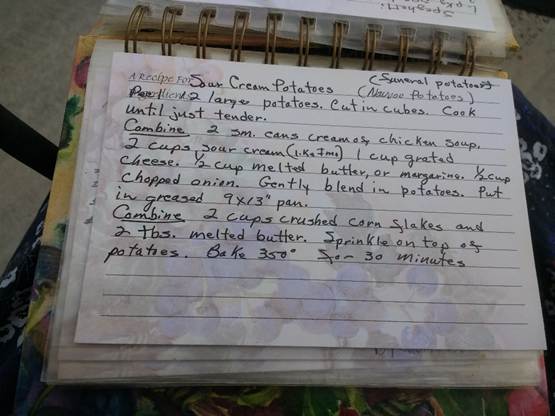
Frequently my family members have asked, “Why are they called Nauvoo Potatoes?  My answer has been “because Nauvoo is where I first had them.”

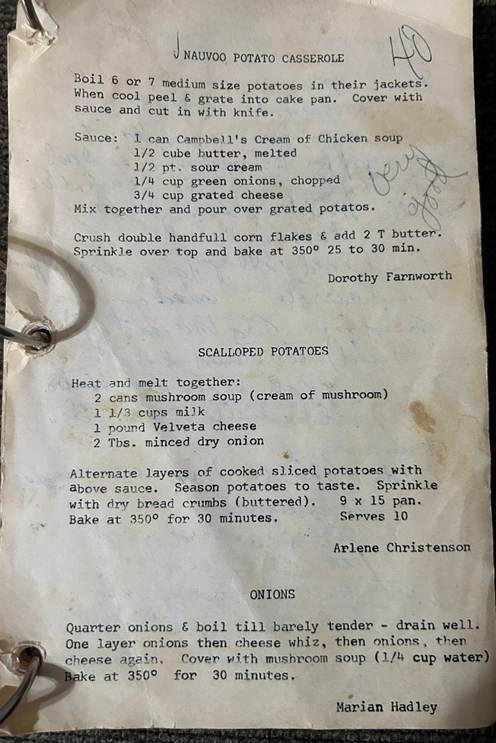
Anyway, in this vintage recipe book, I got excited as I found a recipe for “Nauvoo Potato Casserole” (there you have it!) submitted by Sister Dorothy Farnworth, who then served full-time in the Visitors’ Center.

 I copied the cookbook cover and the Nauvoo Potatoes recipe and sent it out to my family.  They loved it!  Kaylea said, “Oh Wow!  That’s very cool, Dad!  This is some fun history right there.”  Keith said, “Awesome!  It’s still “very good”.  Marinda said, “That is so cool to hear the back story of Nauvoo Potatoes.  Cool cookbook.”   And Lana wrote: “That’s so funny you shared this dad, my kids were just asking less than a week ago why they are called Nauvoo Potatoes.  Ha, Ha!”  I told Lana, “Now you can tell your kids it’s from the Niddy Noddy!”

So, now that I have your mouth watering … here is the original recipe from the “Niddy Noddy”.
THE FAMOUS SCOVIL BAKERY GINGERBREAD COOKIES

My wife also unearthed another small cookbook – which she inherited from her mother – who also served in Nauvoo – from 1979 – 1981.  A folded recipe fell out.  This was for the now famous “Gingerbread Cookies” as made in the Scovil Bakery.  And with it was a little poem about the Nauvoo “Bustle Oven”.  That is the kind of oven that the Scovil family had in their bakery – and it was common in many of the early Nauvoo pioneer kitchens.  For these “ovens” there was an indoor “box” that opened to contain hot fire and coals to heat the oven with.  And outside … well, it was so named because it stuck out like a woman’s bustle.  (I won’t comment on that one!)
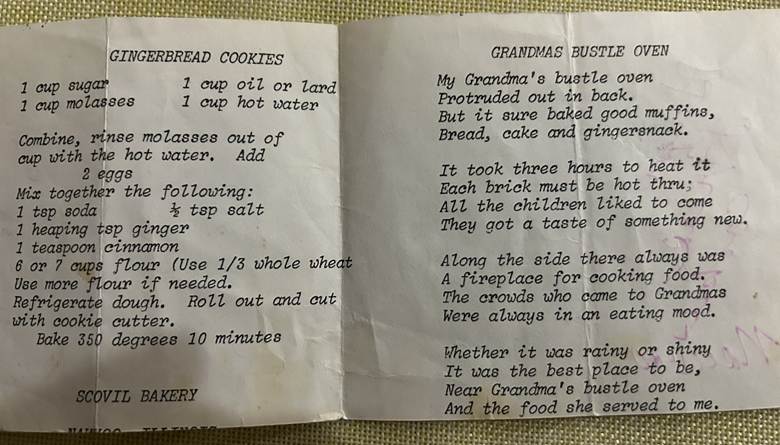
For decades, the Scovil gingerbread cookies (cut to be gingerbread men) were actually baked right there in the Scovil Bakery – in that bustle oven.   And they were one of the “must haves” for anyone visiting Nauvoo.  Children of all ages love them!
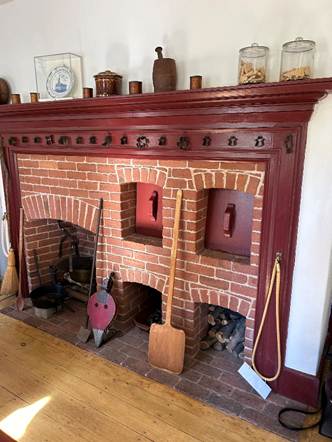
Above:  The double bustle oven arrangement inside the Scovil Bakery.
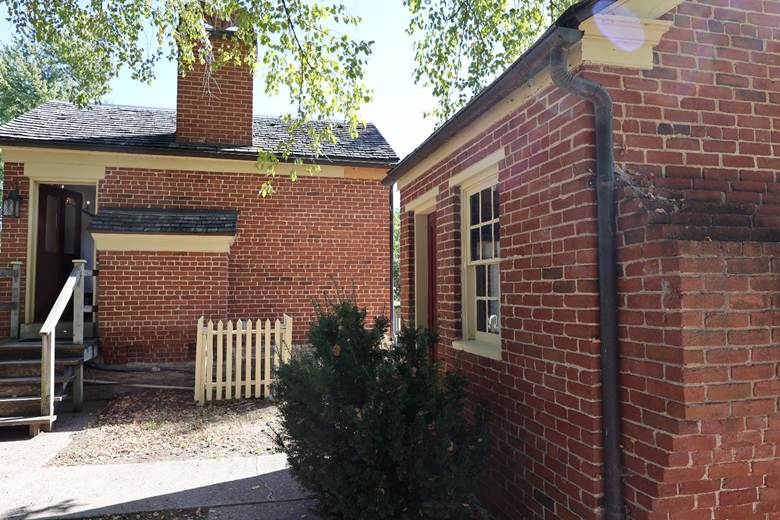
Above:  Double Bustle Ovens behind Scovill Bakery … (Left) behind main house/kitchen and (Right) on the back of the “Summer Kitchen” structure
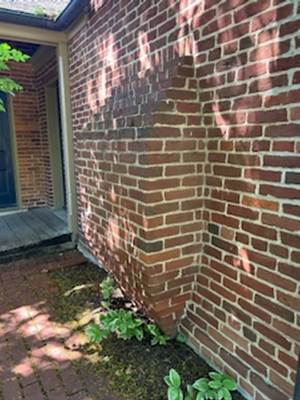
Above:  The Bustle Oven protruding out from the back of the Jonathan Browning kitchen in Nauvoo

The Scovil cookies  nearly went extinct during the COVID-19 pandemic.  That situation meant that the gingerbread men cookies could no longer be baked in this pioneer oven.  Gratefully, the cookies were such a Nauvoo tradition that other options were explored.

When Sister Hunt and I served on our mission in the Scovil Bakery, the Church had contracted with Morgan Squire – the owner of the fun little Nauvoo café called “The Red Front” to make the cookies to be given to Nauvoo guests.  (The Red Front is one of only a scant handful of eating establishments in Nauvoo.)

For one summer, Sister Squire (her staff and family) baked 50,000 of these little cookies.  Imagine that as a cooking project!  Sister Hunt and I were there in the Bakery one time when Morgan came with another installment 5 or 10 thousand cookies.  We helped her transport these down the very steep and curvy stairway into the basement of the bakery.
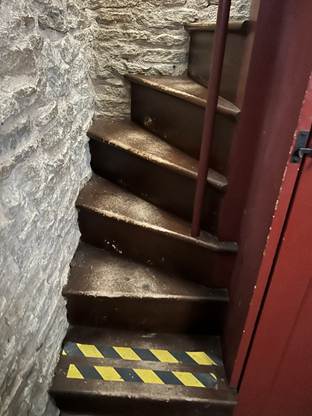
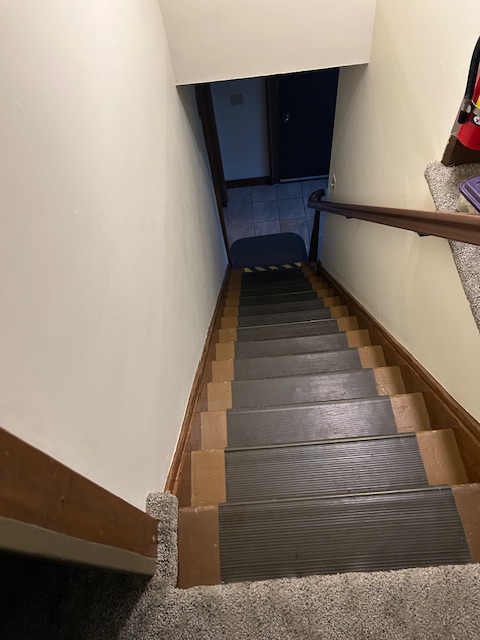
 Above:  The very steep and curvy stairs of the Nauvoo Scovil bakery.

In the basement there was a very pioneer looking deep freeze.  Actually there were two of them – both from the same vintage.
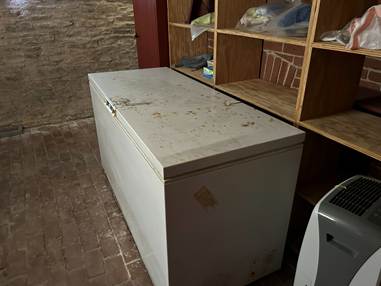
Above:  Gingerbread cookie freezer in the basement of the Scovil Bakery in Nauvoo.

I note that this is the kind of freezer that Grandma used to have in the hallway of the old farm house.  (We used to visit her and Grandpa for a few weeks every summer and that freezer was the favorite of me and all of my cousins.  She had giant Safeway 2 ½ gallon tubs or tanks of ice cream – which we could sneak into multiple times a day as desired.  Wow!  Every kid’s dream).  Anyway, this Scovil freezer was probably one of the original pioneer models.  And it was packed “to the gills” with hundreds of bags of these famous gingerbread cookies (each one being individually bag wrapped in its own cute little bag).
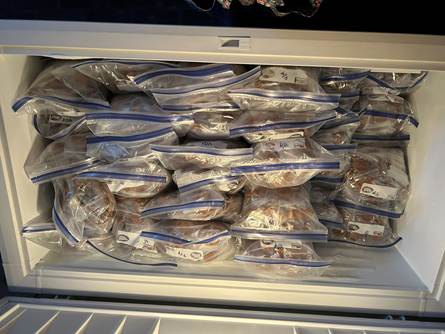
It was interesting as we greeted guests.  Many folks (kids of all ages) had heard of these cookies and they wanted one or more of them.  Some moms had been promising them to kids all day: “If you’re good we’ll get you a cookie at the Bakery”.   Some folks were challenged when we made them sit through our “Scovil” story if they were to be rewarded with a cookie.  And we always promised them cookies “if you’re good”.  And many people found a way to make return visits – asking to skip the speech.

Just a note:  This “fall-out” cookie recipe that we found was tucked into a 1980 cookbook.  The Scovil bakery existed in the pioneer Nauvoo era.  Lucius Scovil took in cakes, cookies, and other delectables “on consignment” so he invited all of the ladies in town (and maybe a few men) to create their very best goods – which  he then sold in his Bakery – making money for him and also for the real bakers too.
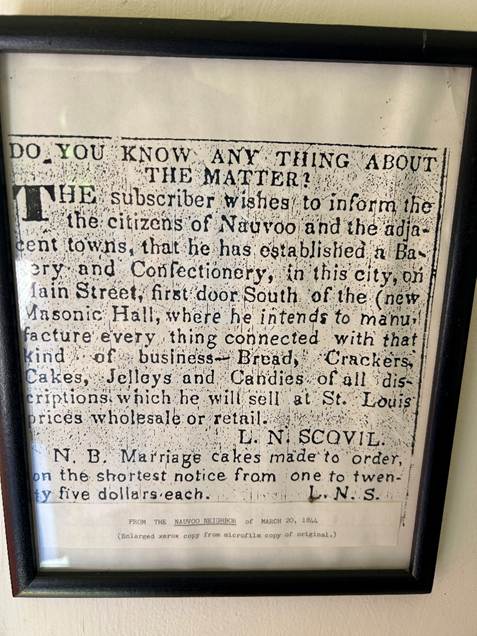
Above: Lucius Scovil marketing the goods at his Scovil Bakery in Nauvoo

I was born out of my time …  With my sweet tooth, The pioneer Scovil Bakery sounds like my kind of place.  I would have very much enjoyed the confectionaries of Mr. Lucius Scovil. 

Over time, the bakery building “disappeared”  at least the part above the ground did.  I think that the cellar or basement remained intact under the ground. 
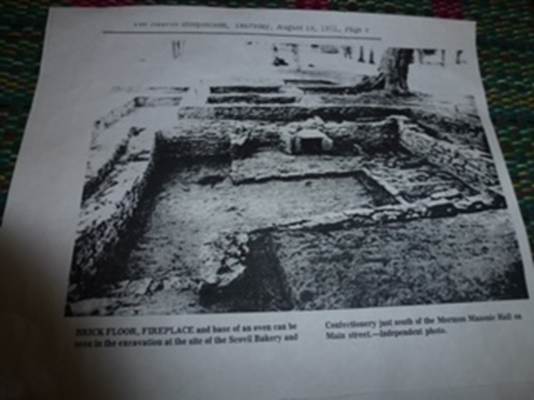
Above:  The underground findings at the excavated Scovil Bakery site

When I was there in Nauvoo in 1975, this building was being reconstructed.  I took some photos of the place as it was being recreated. 
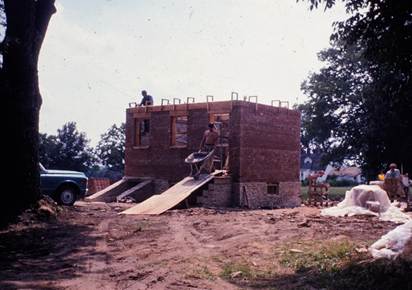
Above:  The Scovil Bakery undergoing reconstruction in 1975.  Photo by Kevin V. Hunt

Rebuilt in 1975 … So, that is why we missed the gingerbread cookies and the recipe in our 1975 Niddy Noddy.

Anyway, after the building reconstruction, the missionaries actually created and cooked the cookies right there in the old now new Scovil Bakery.   Our inspection of the secret inner parts of one of the two inner ovens revealed a modern oven element.  Naughty, Naughty!

MAKING BREAD AT THE FAMILY LIVING CENTER

Another casualty of the COVID epidemic was the hot bread that used to tantalize guests who came to the Family Living Center in Nauvoo.

Like the cookies, this hot bread used to be one of the highlights of any Nauvoo trip.

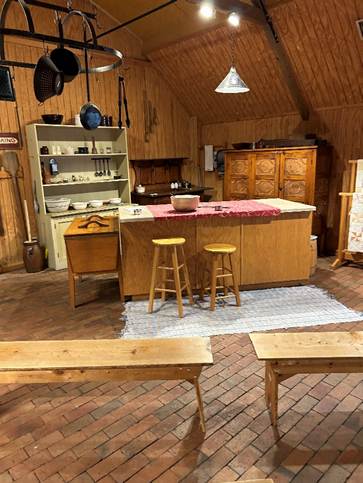
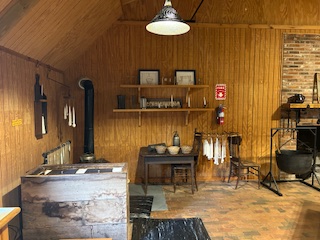
The Family Living Center has a fantastic vintage kitchen.  In all of my Boy Scouting cooking, this would have been the luxury kitchen.
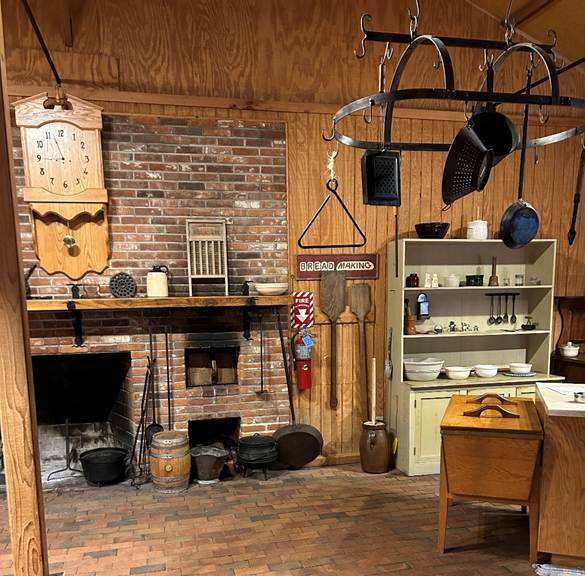
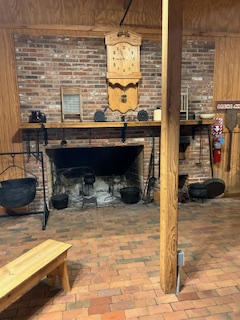
Above:  Luxury pioneer kitchen with fireplace, Dutch ovens, bustle oven (center), bread cooking paddles, many shelves, bread proofer box, and large counter.  It doesn’t get much better than this!

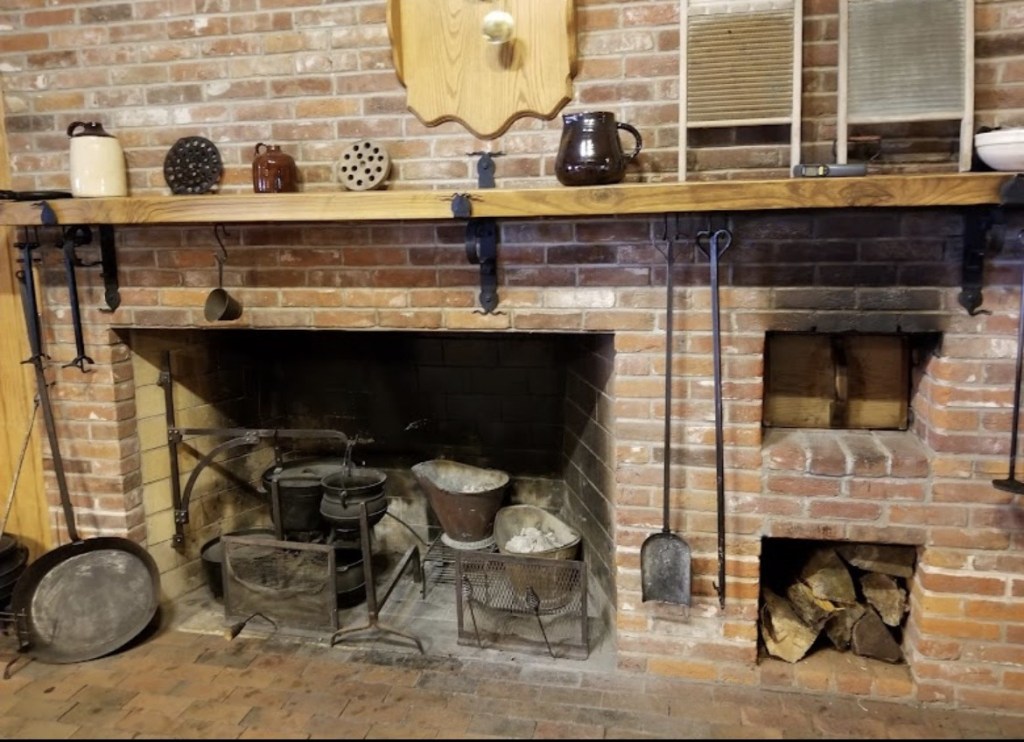
Above:  The Family Living Center fireplace – with bustle oven on right
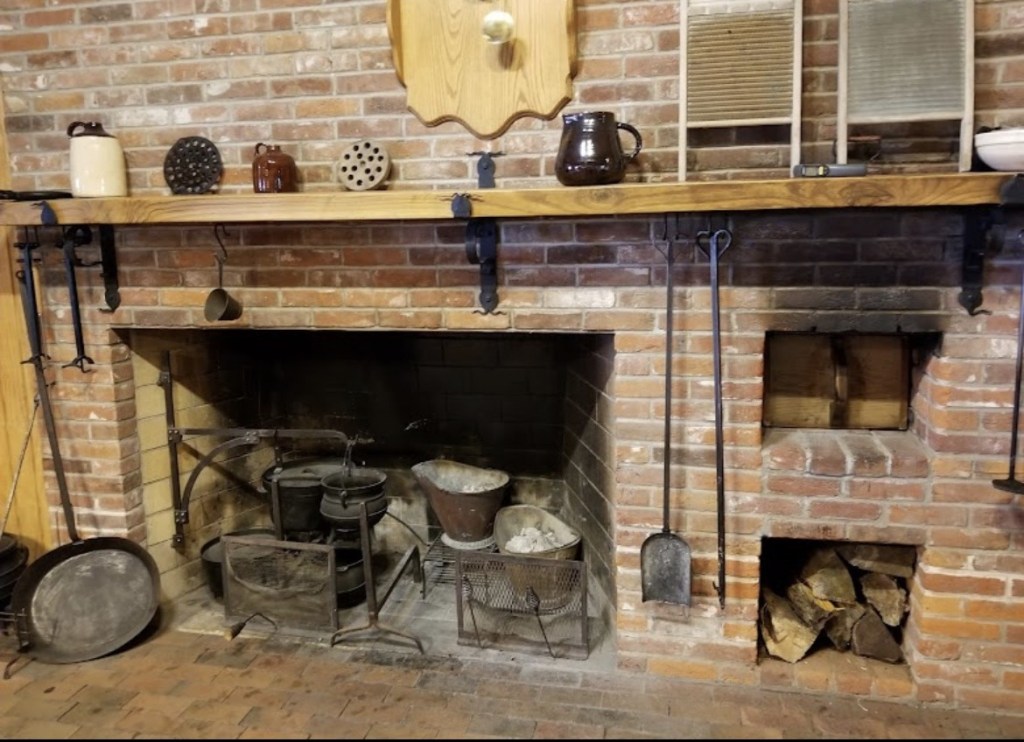
Above:  The teaching kitchen in the Family Living Center

It had a large fireplace for fire – where soup and other great foods could be created.  And it was large enough to generate a lot of hot coals – to be used for Dutch oven cooking – and to fill the “bustle oven”.   
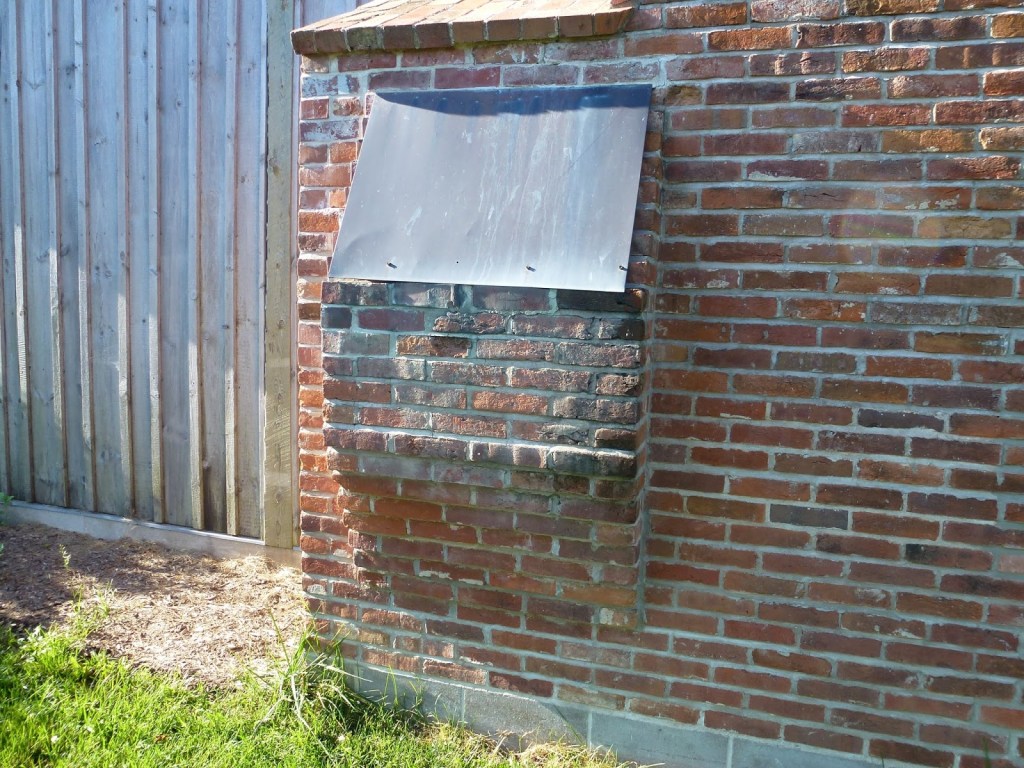
Above: The bustle oven on the backside of the Family Living Center

So, the bustle oven …  this made for a lengthy and prolonged cooking process.  Fire would be added to the bustle oven.  In fact, the fire would be packed such that it would completely fill the available space.  A door would be placed in the oven front.  Then the coals would continue to burn until the fire was completely used up and only coals remained.

While the fire was burning, this became the time to create the bread and other goodies that would later be baked in the oven – once it was “pre-heated” sufficiently.  (Just like cooking in any oven today … it must be pre-heated for best cooking results.)
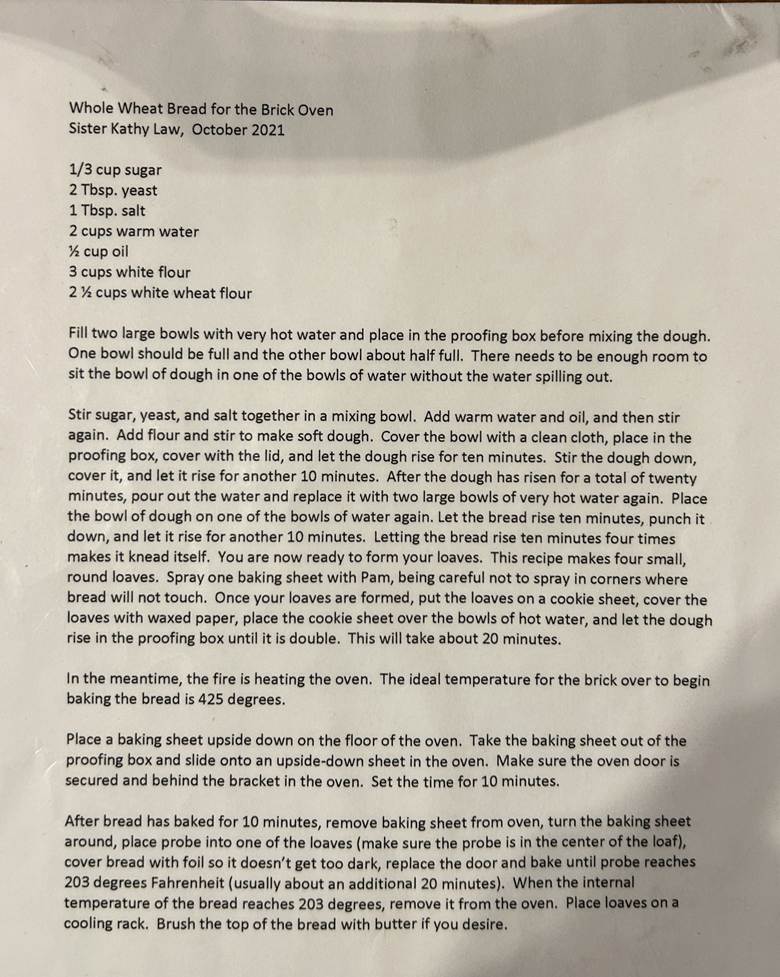
Above:  A modern version of what pioneer women may have baked.  And this was the recipe that we shared in our cooking demonstration at the Family Living Center.

To make bread in the pioneer era …  They often had a large box called a “proofer”.  This had a hinged door at the top.  Inside was placed a large bowl of boiling or very hot water (heated in the nearby fireplace).  Another large bowl with the bread dough was put down on the other side of the water in the box.

The lid would be closed and the dough would be allowed to raise for 10 minutes.  The dough would then be “punched down” and put back into the proofing box for another ten minutes.   By this time, the water would have cooled down and the water would be removed – and probably used for dish, clothes, or people washing.  More hot water would then be retrieved from the fireplace – where hot water was continually being heated. 

The above process of 10 and 10 minutes and punched down again.  After the second 10 minutes, the bread could be formed into loaves, rolls, cinnamon rolls, garlic bread, buns, and everything bread.  Yum!

After the bread or other goods were mixed and ready as per above, the oven would be checked.  If the baker could hold his/her hand in front of the brick oven for less than 10-12 seconds, that was a sign that the oven was hot enough for baking.  If one’s hand could be held there longer, the oven was not hot enough and more fire would likely be needed.  How’s that for a scientific method?
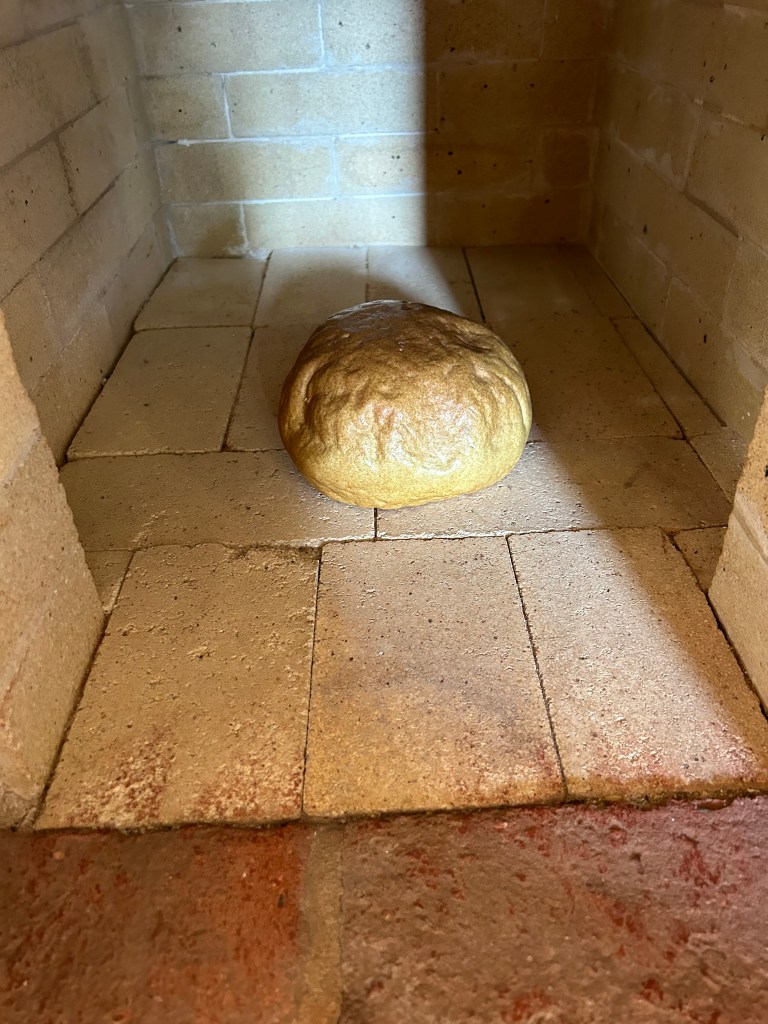
If the above test was passed, then the coals would be removed from the oven (and saved for soap making … nothing in the pioneer world was wasted …).  And by this time, all of the bricks that surrounded the oven on all sides – were very hot.  And then it was time to insert the bread.

Above:  bread cooked in the bustle oven

The bustle oven operated much the way that today’s pizza oven operates.  A bit of corn meal was spread onto the hot bricks to keep the bread from sticking to them.  Then the bread loaves could be placed into the oven using a large paddle (again with corn meal sprinkles) – like a pizza paddle.  

Being an old baker from years of Boy Scouts, and filling many a Dutch oven with cakes, pies, cookies, and cobblers, I loved giving this bread making demonstration to guests who came.

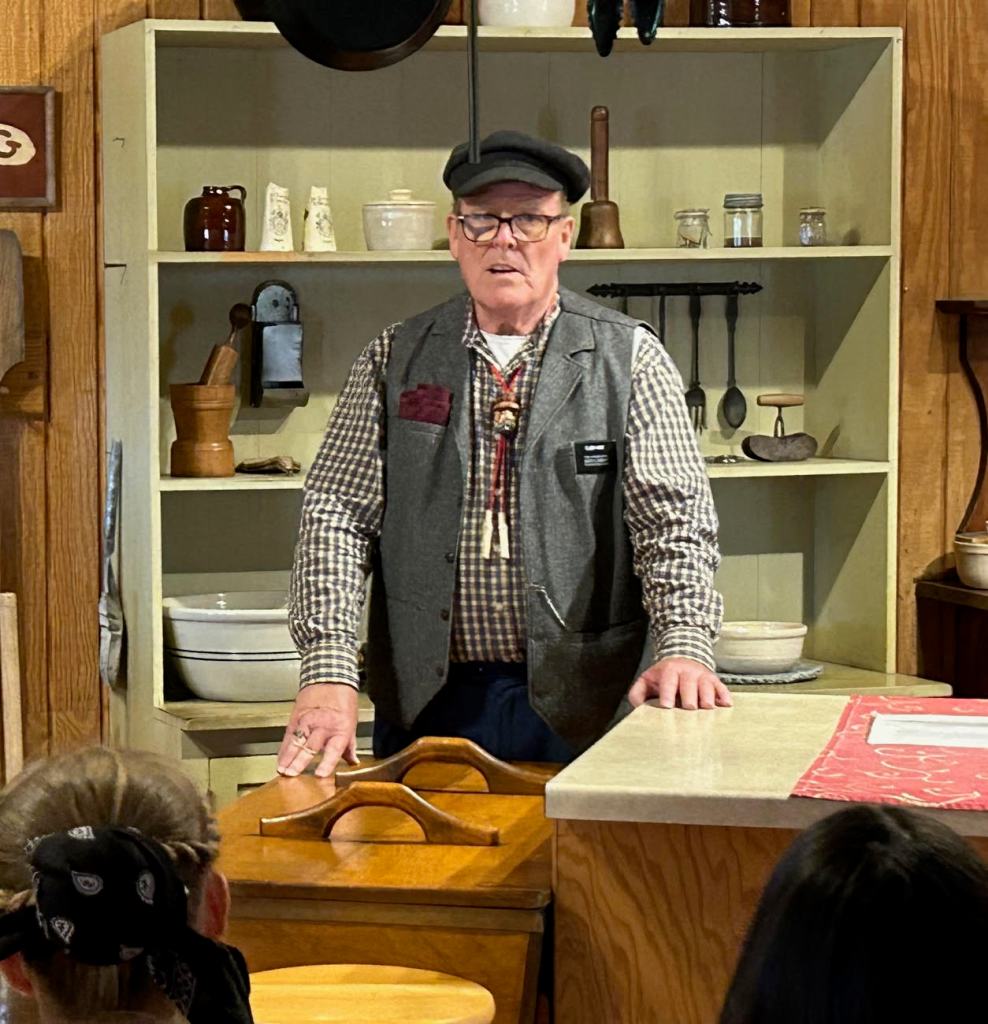
Back in the day – like Pre-COVID, missionaries actually made, cooked and served their wonderful bread to the Nauvoo guests.  But, sadly, this tradition and cooking method actually died in the pandemic.  So sad!  So when I gave this cooking demonstration, I warned the folks that I would be happy to teach them the skill of bread making +but they would “have to use their imagination” relative to the hot tasty bread.  I still had a lot of takers for the demo, however.

I could speak and teach emphatically on this subject of bread making.  I grew up with a mother and grandmother who made bread several times each week – and have a wife who is one of the greatest baker of breads and rolls of every variation.  It was always such a treat to come home (even when I was older) just in time to get some of Mom’s delicious bread as she took it out of the oven.  [And I note that she made the weekly sacrament bread for over 30 years – in two different wards!]

 I guess this bread-making skill is kind of a dying art.  Maybe that’s why the people were so interested in it.
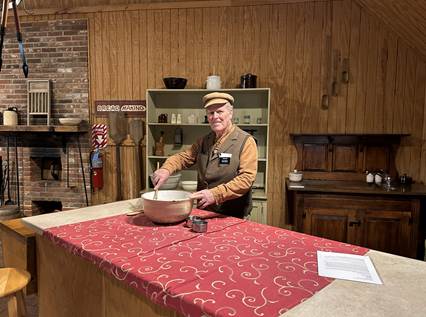
Above:  Elder Kevin Hunt teaching bread making at the Family Living Center

I always told the young ladies on the tour that if they really wanted to impress the boys, they should learn to make bread.  I told them that all guys (young and old) absolutely love hot home-made bread.  I said, “Your bread is the way to win their hearts” (after their stomachs are first filled with their yummy bread).   I hope that I made some of the ladies believers.  Maybe their husbands will thank me later!

EMMA SMITH MADE SCONES

Another of my favorite Nauvoo food talks was in the Mansion House – owned by Joseph and Emma Smith.  It was fun to tell our guests that Emma often cooked scones in the Mansion House.  Yes, folks, Emma cooked those wonderful fried balls of dough – with honey.  Yumm!

Scones often became Emma’s “go-to meal” as Joseph sometimes gave her little notice of a meal – probably to feed a crowd. And often she probably lacked resources (flour, etc.) to make other “better” foods.  Her guests loved her scones. 

One guy (likely a highfaluting guest) was especially impressed.  He said something like, “These are wonderful! What do you call them?”  She smiled slyly and said, “I call them ‘CANDIDATES”.  And then the guy asked her, “Why do you call them “CANDIDATES”?  I am sure that she enjoyed digging him with the answer, “Because they are puffed up and full of air!” (Zing!)

Emma Smith was born July 10 (1804).  As Sister Hunt and I were in Nauvoo, a great-granddaughter of Emma staged an annual small gathering in honor of Emma’s birthday. She staged this at Emma’s gravesite.  And a major feature (steeped in tradition) was serving Emma’s famous scones.

On one July 10, Lou and I were serving at nearby Joseph’s Red Brick Store.  Knowing of the Emma event, I told Lou and all of the young sisters that I would man the store (giving all the tours) and encouraged them to attend the Emma event.  (I still got a good deal out of this arrangement, however.  As ever, my wonderful wife brought back some of the delicious scones for me.  Yum!)

Emma’s scone recipe is pretty simple … but still very tasty:
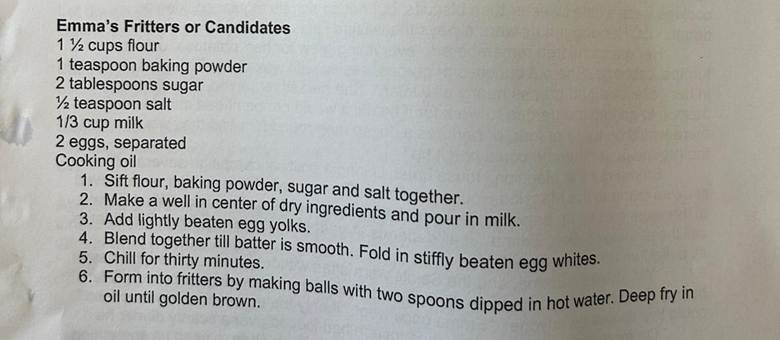
And here is another Emma recipe:  (She must have been a great cook!)
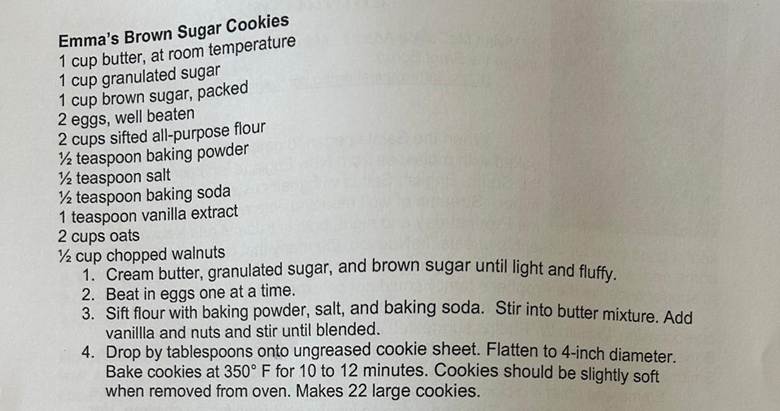
PIONEER COOKING

Most women of the Nauvoo pioneer era cooked directly on a fire and generally using Dutch ovens and other cast iron pots.  This is evidenced by the following fireplaces.
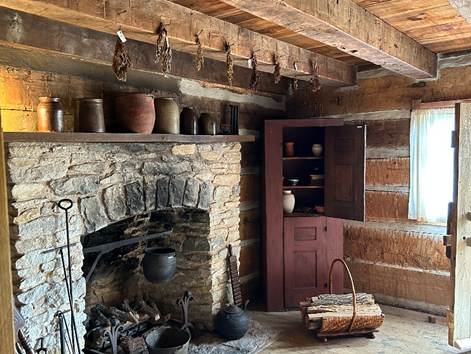
Above:  Pioneer kitchen and cooking as shown in the restored Benjamin Bird Cabin behind the Browning home
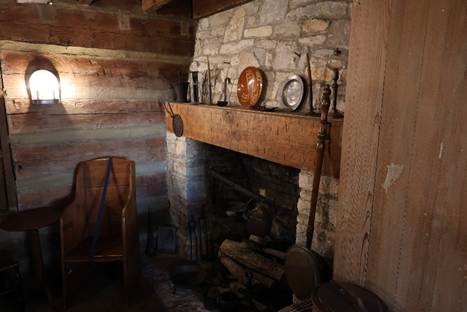
Above:  Cooking fireplace at the Nauvoo Homestead of Joseph and Emma Smith (built 1826 by James Smith prior to the arrival of the Latter-day Saints)

I personally love the cooking arrangements in the very original Sarah Granger Kimball home.  They had two fireplaces – back to back.  One was for heat in the parlor room.  The other was their main cooking fire – located right in the entryway room.  And in the wall between the two fireplaces, they had another hidden oven.  It was not a bustle oven but it operated on the same principle.
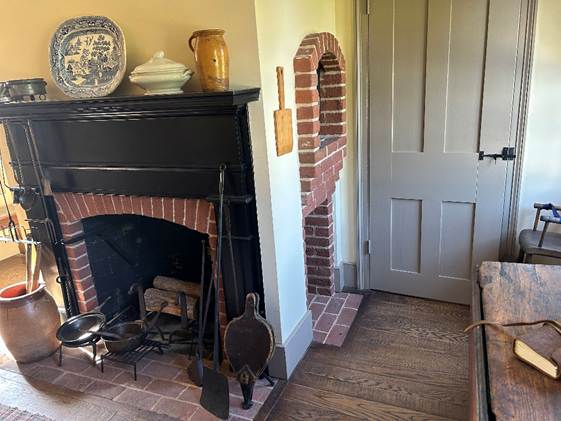
Above:  The Sarah Granger Kimball cooking fireplace with the hidden oven (in the center of the photo) used for baking.  The area below could be used to store firewood or coals.

MY FAMOUS DUTCH OVEN STEW

My Dutch oven stew did not originate in Nauvoo but it does have a long and yummy heritage.  I remember when and where I was lucky enough to acquire this recipe.

Back about 1980, I was a professional with the Boy Scouts.  I often had duties up at Camp Kiesel – located up Ogden Canyon – about 20 miles east of Ogden, Utah.  I had duties of helping for big events held up there.  Camp Kiesel was blessed with Cook Muriel.  Muriel was one of the greatest camp cooks that I have ever met (or dined from).  She often had to cook for a hundred or two for weekend meals.  One of her best meals for a crowd was her stew – made with plenty of fabulous biscuits.  She gave me the recipe and of course, I named it “Muriel’s Stew”.  I loved it – and made it many times.

Sadly, however, I somehow lost the recipe over time and it was forgotten. Then later I was reading in some of my past personal journals and there it was.  I had recorded the recipe in the journal.  Wow!  (Sometimes I impress even myself!)
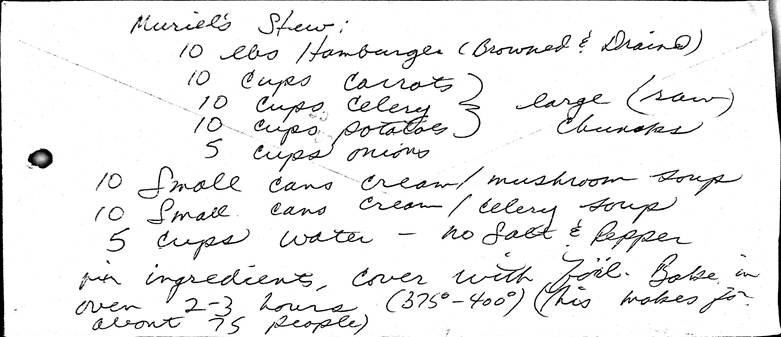
Above:  Muriel’s Camp Kiesel Stew recipe

Anyway, on two occasions in Nauvoo, I staged and hosted Dutch oven dinners for some missionary groups.  Muriel’s stew was the perfect meal to cook.  (I had a large collection of Dutch ovens at home – but in Nauvoo, I didn’t have even one.  I had to buy another 14” oven – just for these Nauvoo occasions.)
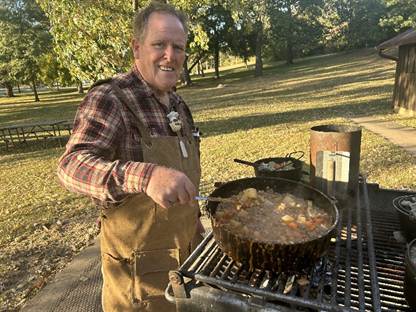
One such dinner was for our Brigham District.  And the other event was for about 40 people – a reunion gathering comprised mostly of couples who were with us at the Provo, Utah MTC – where we gathered to learn and prepare for our Nauvoo missions.  I think that the missionaries were impressed with Muriel’s stew – as I had been over the years.

This was not a pioneer era Nauvoo recipe, but Emma and Lucius Scovil probably would have liked it (but they would have had to create their own cream soups).   I cooked the stew twice in Nauvoo – and the recipe was already 50 or more years old when I made it in Nauvoo.  It has stood the test of time.  If Muriel had been serving in Nauvoo she probably would have included her recipe in the Niddy Noddy.  I know I would have if I had lived in the day of the Niddy Noddy.  Anyway, thanks, Muriel, for the great heritage recipe.

And may the spirit and heritage of the Nauvoo Niddy Noddy live on!  We can’t get enough of that great Nauvoo food.
Saving the Coolidge House and Pioneer Crafts

Blog #64

By Kevin V. Hunt

At the funeral for her father, Everett H. Belcher, all of the nine Belcher siblings were assigned to speak to a different subject about his life. 

Above: Sister Verna Belcher and Elder E. H. Belcher

Brother Belcher had thought out his funeral and had picked the subjects he wanted shared in his service.  My wife, Lou Dene Belcher Hunt, was assigned “Saving the Coolidge House”.  She was really baffled about this request.  She knew little about the place.   She said, “I didn’t know enough about the Coolidge House to talk about it.  I wanted to talk more about my personal relationship with my father so the Coolidge House seemed ‘kind of our there’.”

That was back in July of 2004.  Now twenty plus years later, Lou Dene says, “Looking back, and with events that have happened since, I wish I had talked with him more about the place.  There is much that I would or should have asked him.”  Sister Hunt said, “I did come up with a little bit about the place (with help from Dad!). 

This is what Lou said in her talk about her father:

“I have a brown bag, because this is going to be a brown bag talk [in the tradition of her father].

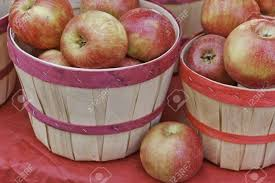
We had an apple orchard on our place when we were growing up and my Dad didn’t like us to waste apples.  And if he found a half-eaten apple, he would make sure you finished it core and all.  My Dad made us pick all the apples and put them in the cellar to keep.  We could eat as many apples as we wanted to as long as we ate the ones with the brown rotten spots first.  I have a poem that I will read to you about our apple eating days.

We brought them from the cellar, The apples with the spots.

Of the good ones left behind, by tomorrow some would rot.

“Bring the apples that are spoiling”, our mother used to say.

“We’ll always eat those first, and I’ll pare the spots away.”

In the evening by the fire, we had story and we had song,

And we had rotten apples all winter long

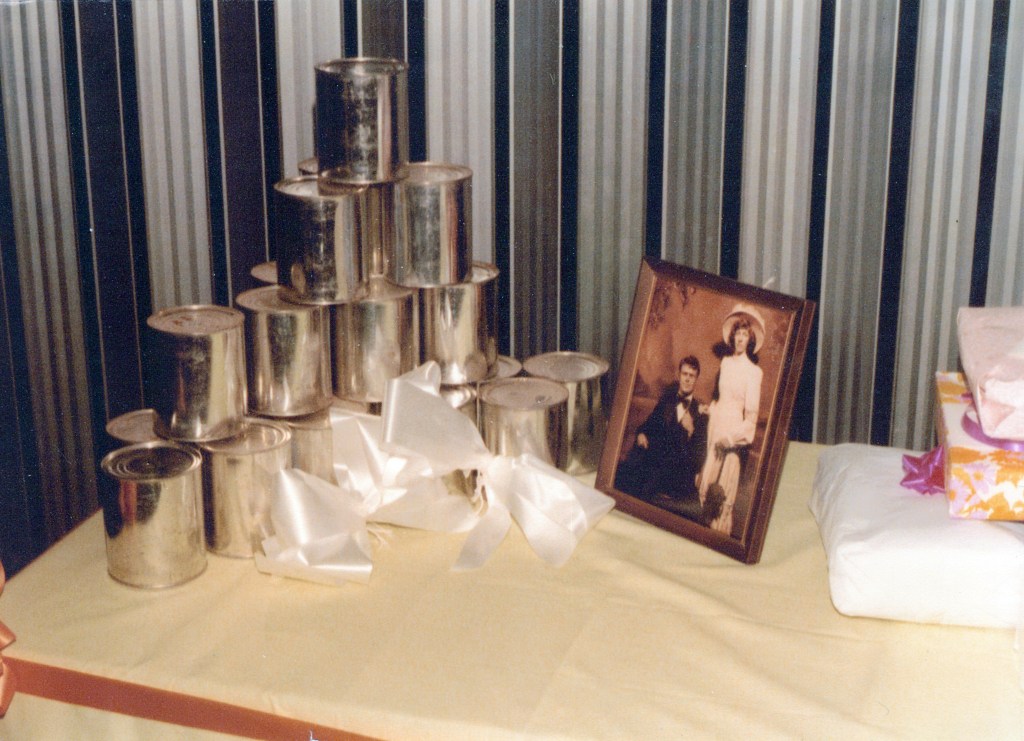
We ate a lot of rotten apples.   One year my Dad had us can all our apples at the church cannery.  And this was a big family project. And we canned a lot of applesauce before we were finished.  We figured my parents could feed us a can of apple sauce each and every day and it would last them 3 years.  That was a lot of applesauce.  Like in the church movie “Johnny Lingo and Mahana, the eight-cow wife”, my Dad offered 5 cases of applesauce when you got married. This was a great family tradition and we had a lot of fun with this. I was a three-case applesauce wife.  I guess we had eaten all of the applesauce over the years. I don’t have the original can, but I have pictures out there on one of the tables.  This is the applesauce.

“My husband and I tried to carry on this tradition with our family.  We have had 3 girls get married and when their husbands came to town, because our last name is Hunt, we have offered their husbands 3 cases of Hunt’s Tomato Sauce. We have kept it in the family.  So, they have enjoyed their tomato sauce.

“Like the story of the rotten apples my Dad didn’t want any of us to get spoiled or go rotten and he did this by keeping us very busy working, a lot.  We grew a garden each summer.  We had to prepare the soil, plant the seeds, weed and water, and the water was often a late-night irrigation.  We grew a lot of corn in our garden, and we would sell it at the end of our lane at 50 cents a dozen. We would use the money to buy our school clothes and one year we used it to add to our church’s building fund.

“We had a lot of family traditions growing up.  Much like the tradition of the applesauce we had the tradition to read scriptures, go to church, pay tithing, and have family Home Evening.  As the book of Mormon says, “they were taught in the tradition of their fathers[DKB1] .”  We to were taught in the tradition of our father.  We were taught to work hard and trust in the Lord.  Thank you, Dad, for these traditions.

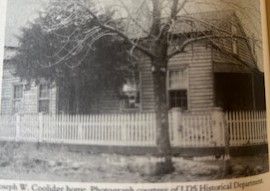
“And in closing my Dad wanted each of us to talk about his accomplishments.  When my Dad was serving in Nauvoo on a mission.  He took it upon himself to save the Joseph Coolidge House that was going to be torn down.  Its foundation was rotten, like all the rotten apples that he saved growing up.  My Dad saved the Coolidge house, and I have a picture of it right here.

 Above: Vintage photo of the Coolidge House (before the time of Elder Belcher)

It was turned into a craft house with candle making, barrel making and pottery and this now houses missionary couples.  Good job, Dad.

“A month ago, when we were visiting my Dad, he told us what he wanted us to talk about at his funeral. 

Finally, my husband said “Don’t worry Gramps, all your accomplishments will be sitting in the benches in front of you.  And there you are, a whole chapel full of his posterity.  My Dad was very proud of his family.  He told me many times that he was blessed with a wonderful family and he said, “How could a person be so lucky to have every member of his family active in the church?”  We are following in the footsteps of our father.  I am thankful for a father who believed in us and taught us the ways of the Lord.  I am thankful that my Dad can be reunited with my mother.  What a grand reunion that must be.  They have both blessed my life and that of my family.  I love you Dad.  In the name of Jesus Christ Amen.”

Little did Sister Hunt realize that the Coolidge House would impact her life personally 20-plus years later.

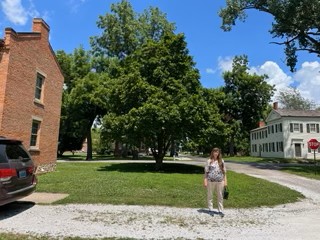
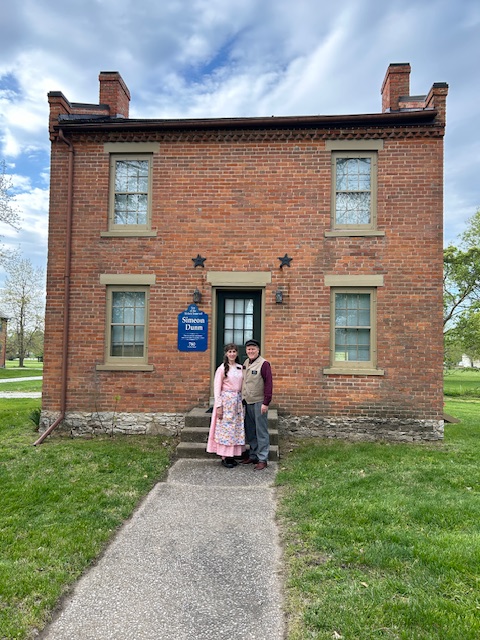
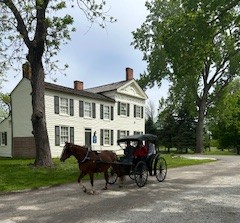
Sister Hunt and I came to Nauvoo in April 2024 to serve as “Site Missionaries”.  We were assigned to live in the historic home of Simeon A. Dunn at the SW corner of Hyde and Parley Streets.  This home is located “kitty corner” to the Coolidge House (on the NE corner).

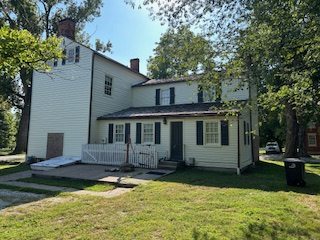
Above: Sister Lou Hunt standing in the drive between the Dunn Home (on left) and the Coolidge House (on the right)

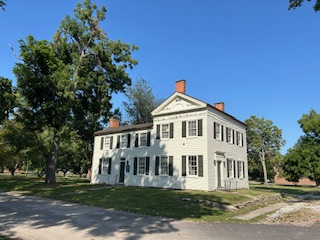
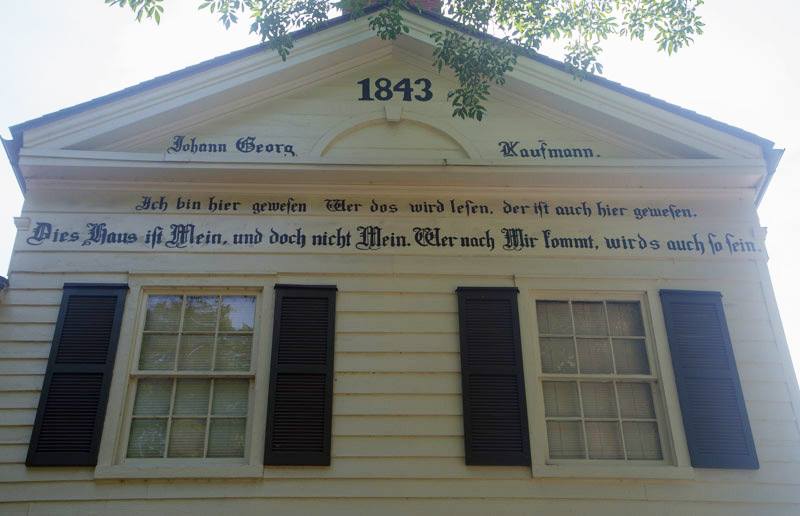
So, we literally look at the Coolidge House and think about it many times a day as we go to and from our house.  It is such a beautiful place and seems so majestic.  And the German writing on the place is interesting and intriguing.

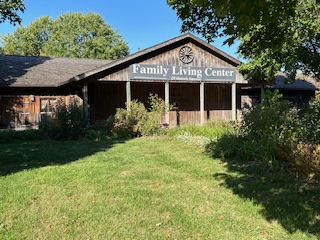
One of our favorite sites where we serve with our tours is the Family Living Center.   

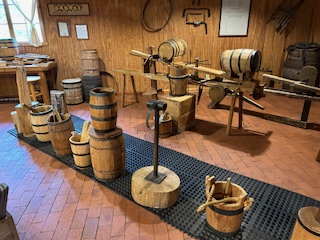
This is a place of joy and happiness for children (and adults who get to act like children).  It really is a FUN place.  In the place, we give “hands on” demonstrations on candle making, bread making (though COVID killed the actual bread making demo), wool and spinning, looms and weaving, packing the wagon to go west, barrel making, and rope making. 

And of particular interest – in at least a snippet of the Belcher tradition, we also get to talk of and demonstrate the Belcher perfected art of brick making.  We talk of brick-making in general in Nauvoo and often the kids get to “throw their own brick” by pressing Nauvoo clay into a small mold box. Though not in the script, Sister Hunt almost always gets to share the historic story of the souvenir Nauvoo Brick which all Nauvoo guests get to take home.  It is so fun for her to say, “My dad started this brick and designed the imprint.”  This comes as an initial shock: “Yeah, right …” but then by the end of her presentation about him and bricks, the folks are in total awe and say, “Wow!  That is just so cool!”  She makes sure that each guest leaves with a small brick in hand.  

The Family Living Center of today with all of its craft demos got its start from the Coolidge House here in Nauvoo.  Elder Belcher did not build the Coolidge house, but the place owes much to the efforts and vision of Elder E. H. Belcher.   He literally saved the house from the demolition ball.

ABOUT JOSEPH WELLINGTON COOLIDGE

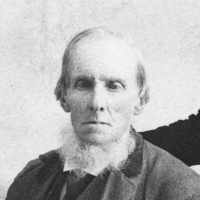
Joseph Wellington Coolidge

View in FamilySearch

Joseph Wellington Coolidge

31 May 1814 – 13 Jan 1871

Joseph Wellington Coolidge (1814-1871) was born 31 May 1814 in Bangor, Hancock Co., Maine. He was the son of John Kittridge Coolidge and Rebecca Stone Wellington. He married Elizabeth Buchannan on 17 Dec. 1834; participated in plural marriage. He was baptized before Jan. 1838. He was a member of the Nauvoo Legion and on the Council of Fifty in Nauvoo along with Wilford Woodruff. He died 13 Jan. 1871 in Coonsville, Mills Co., Iowa.

BACKGROUND HISTORY OF THE COOLIDGE HOUSE

Joseph W. Coolidge built this house himself in 1843.  This is the date shown on the outside of the house.  He was from Maine and was a cooper, carpenter, and building contractor.  He lived in the front part of the house and used the other part for his shop.  He was a trusted friend to Joseph and Emma Smith.  At Emma’s request, he became the administrator of Joseph’s estate three months after the prophet was killed.  He asked to be released from that duty in the spring of 1846, to go west with the main body of the Latter-day Saints.

THE COOLIDGE HOUSE AFTER JOSEPH WENT WEST

The next owner of the place was Johann George Kaufmann.  He made the house into a hotel.  He painted the quaint German saying on the front of the house.  The lettering (by translation) says, “This house is mine, and yet not mine.  For him who comes after me, it will also so be.  I have been here.  Whoever reads this will also have been here.”

So, kind of odd … what does it mean?  Maybe it reminds us how temporary our hold is on earthly possessions.  Local tradition gives it a meaning of hospitality … and since the house was a hotel when Mr. Kaufman had it, that would be appropriate.

The place was remodeled to be a restaurant sometime after 1932.  In the 1970’s Nauvoo Restoration acquired the house.

THE COOLIDGE HOUSE BEFORE RESTORATION

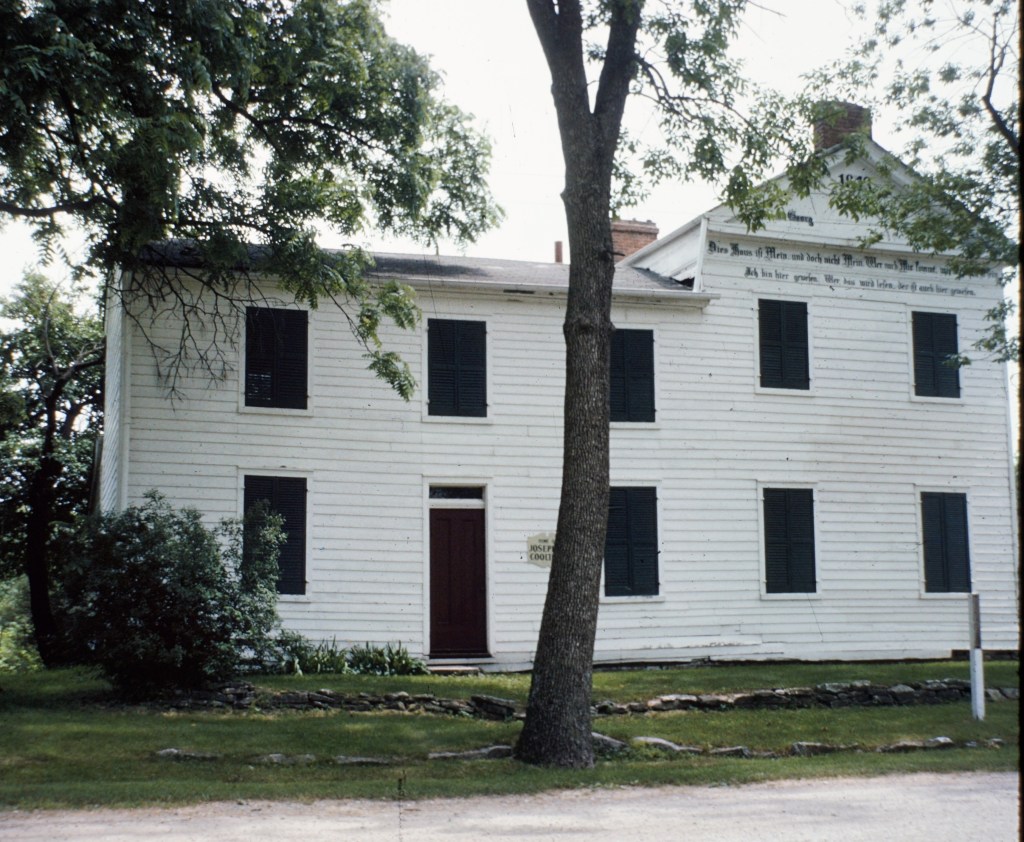
Collidge House in 1975 – Photo taken by Kevin Hunt as a young missionary in Nauvoo

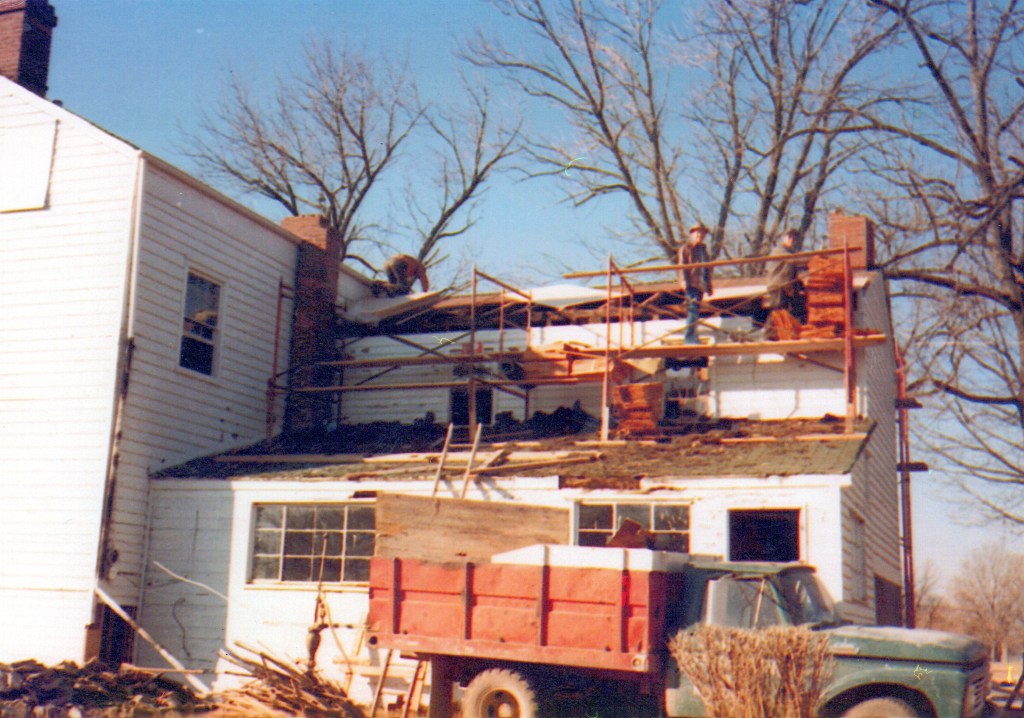
It is no secret that I (Elder Hunt) served in Nauvoo as a young missionary – literally 50 years ago in 1975.  While here then, I took a photo of the Coolidge house.  It was then still in pretty good shape.  Something must have happened to it before 1980 when Elder E.H. and Verna Belcher, my wife’s parents, came to serve in Nauvoo.  Elder Belcher describes the building’s state when he was here serving in the Lucy Mack Smith home and the Brickyard.

SAVING THE NAUVOO COOLIDGE HOUSE

The Account by Elder E. H. Belcher as dictated to his grandson, John Bollwinkel

“One day the President [Dr. J. Le Roy Kimball] came by the Lucy Mack Smith home – where I worked – and said he wanted me to look at a house down on the next corner.  It was the Coolidge home.  It was a big beautiful white lumber home.  Most Nauvoo homes that survived from the Pioneer era were brick.  Most lumber buildings had gone by the wayside years ago.  But this one had been kept up, but the whole wall at the top had rotted out and the roof was sagging and was loose and the ceiling was in bad shape.  He said, “Go down with me and see what we have to get out before they bulldoze the house down.”   He said, “If someone gets in there it is going to fall down and kill them.”

“So we went down there, and that is when I could see what a beautiful building it was and what beautiful workmanship.  Oh man, it just haunted me.  So this was Friday night when we went down there.  And Saturday morning early I went up to the president’s house and told him “I cand shore it up, I have moved buildings and I know I can shore it up – so it won’t fall down and can use some lumber to get it stabilized.”  He said, “Ah Naw, we are going to tear it down.”  Then I coaxed and coaxed him, and I must have stayed there quite a little bit and he couldn’t get rid of me.

“And he finally said, “Well go ahead.”  So, I went down and tore the siding off of about 5 feet high wall where it was all rotted off.  Then I doubled up the timbers and stabilized them and so forth on that whole side.  And about 5:00 that afternoon the President came driving by and he drove by slowly and looked and looked and of course, I had this whole side off up about four feet up.  And the next morning they had priesthood meeting before we went to work.  I woke up in the night and in my mind, the hole kept getting bigger and bigger and bigger and I was about to get out of bed and go down there. 

Above: The back (east) side of the Coolidge House while under Belcher restoration efforts

The next morning the President said, “I’m telling you to get down there and either tear it out or patch it up.”  I said, “Just hold off and don’t get too excited – just hold off, just hold off.”  So, he said “OK”.  So, I went back and got that taken care of and then I got to another part of it and worked on it and I worked on one then and another part that needed fixing.  And again, I was using material that wasn’t meant for that project.  And the project manager was having fits all the time. “It will never stay, because they will have to see what the original foundation was and the architectural and the historical background and that everyone is upset with what you are doing with it. You should go through the right channels.   It has to goes through a 2 year process before you can start on anything.”

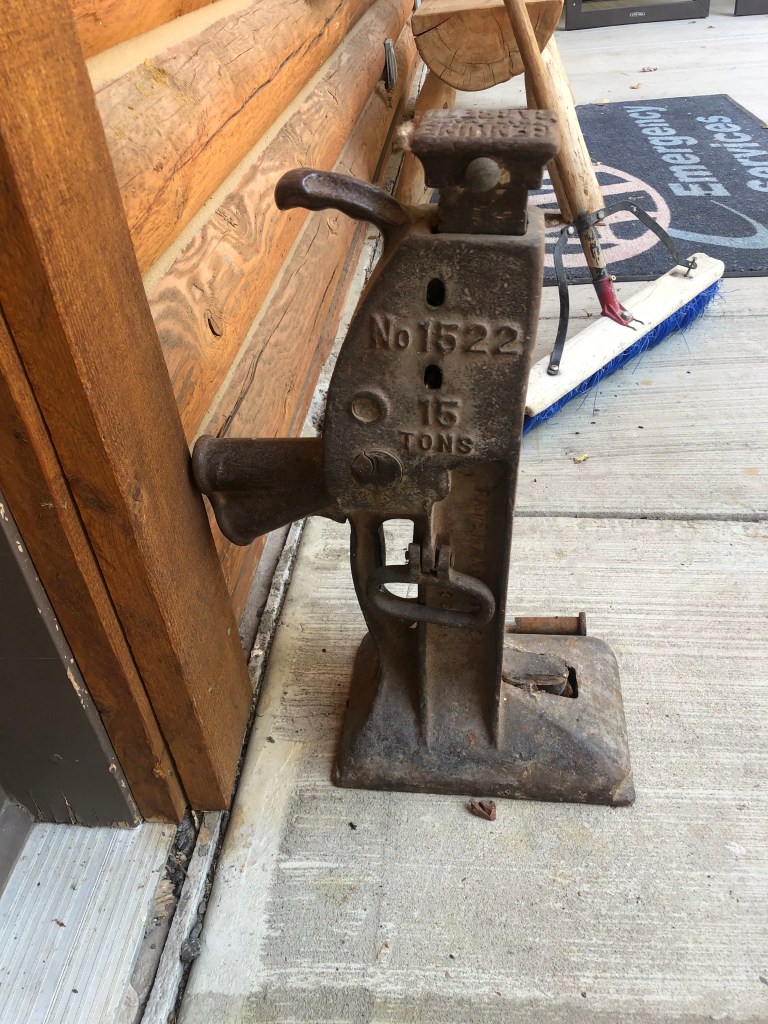
(John “I remember you calling Vern for your house jacks?”) “Yaw, I had to have them to jack up that wall.  I’ve got a picture of the mission president jacking up one of those jacks.  I keep a going there and the roof was a saggin’ and I got it straightened up and had part of the plywood on and I decided to get started shingling and try to get it closed in. [Note:  We would love to have that classy photo but we don’t who in the family might have it.}

“I couldn’t get any help there because all the other missionaries all said it was a waste of time because they said they were just going to tear it down.  Everybody was down on me.  (John “What was happening to the brick yard while you were doing this?”)  I was fixing the building at night and on my spare time and the slower part of the year and the likes.  I couldn’t get anybody to help me.  One guy finally agreed to help me.  And so he was the one that was helping me to get the building ready. 

“When we got ready to put on some shingles on the part that I had to rebuild, I finally got 5 missionaries to help put on the shingles.  We got the scaffolding all up there and got it ready and got up there and started putting on the shingles and here comes the project engineer.  He said, “You don’t know how far those should come out and you don’t know what kind of a corners to have under that and you haven’t researched the details and you are just wasting your time and we are still going to tear it out.”  And he made a big to-do about it, and you couldn’t tell the guys now you just keep on shingling.   And he was about to shut it down. 

 “I said “Well we have got a hole up there and it doesn’t matter, the roof’s going on anyway or the storm will get in.  So I lined up some plastic and fixed it so it wouldn’t leak.  And I kept plastic on it for about six months.  And by that time I got all the other done and got it up so I could go ahead on the shingles and we went from one thing to another like that and we keep going along.  In fact this one brother who came there was a finish carpenter when he came there.  I was showing him around and he was looking around and he said “Boy this is a beautiful building. I sure would love to work on this.”  I said, “Well we will give you plenty of opportunity, you come around and you can help us.”  And it went on and he never came around and he never showed up.  I finally seen him and said, “I thought you were going to come and help.”  And he said, “I didn’t want anything to do with that, that’s the worst thing that has happened since the saints left here.”   So you could tell the missionary scuttle butt that was going around from then on. 

”So we just kept going and that’s when finally the president cane by and said, “Don’t let them stop you, don’t let them stop you.”  So then they asked us to stay another six months and another six months to finish all these projects, it was great.  We stayed for two and half years.  And the first carpenter stayed with me all the way and it wasn’t quite finished when I left, and he stayed and finished it up. 

Above: Back side of Coolidge home – after Belcher restoration – and as it looks in 2025

“What a beautiful mansion – and a complement to the original builders and to Joseph Coolidge [who also built Joseph Smith’s mansion House – in the same architectural style and of the same white slat wood.]  And in spite of all the odds, the restoration was completed. Beautiful white pine was used on the frame of the building because the Saints didn’t have streams to harness for power to be able to saw lumber and also the pine wasn’t too available in the area.  Arrangements were made by the saints to use a sawmill located up the Mississippi River and East – on a tributary towards Chicago – and where Chicago had obtained a lot of their lumber.

“Beautiful white pine located there was sawed and then placed on the ice in the winter.  They shaped a barge by bowering holes and putting small piles down through it to tie it all together.  When the ice melted the barge began to float down the river into the Mississippi and then on to Nauvoo.  This was some of the lumber that was used in the Coolidge Home.  The floor joists had two-inch holes irregular in them indicating where the small poles tied them together to make them into a barge.”

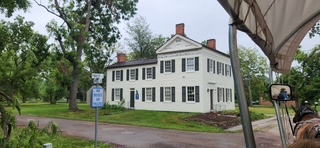
Above: Coolidge House 2024 from view looking out from the wagon ride

SOME INTERESTING PHOTOS OF THE CURRENT COOLIDGE HOUSE

Above: Look at this lovely woodwork color in the current Coolidge Home (Upstairs apartment) … we think this remodel was completed after the time of Elder Belcher

Above: Cut-out of wall from downstairs apartment looking upward to upstairs of Coolidge house

(John “So what happened to the Coolidge house?”) 

DEMONSTRATING CRAFTS IN THE COOLIDGE HOUSE

A few months ago, Sister Hunt and I met a local worker in the Facilities Maintenance area of our sites (an emmployee named Jodi). She grew up in Nauvoo and remembers coming to the Brickyard. She remembers Elder Belcher saying that he wanted to find a way to engage young children more in Nauvoo – and so he wanted to start craft demonstrations. Wow! So cool.

Elder Belcher continues:  “One brother – wanted to get coopering or barrel making going.  He thought it would go well with my brick making that was going over so well, but the president said that we didn’t have any place to do it.  So I was pushing to get this building for that.  So I took one of the carpenters down to the barrel making place [somewhere south of town)and he got the idea of the barrel making.  It is still there.”

“And I got rope making, barrel making and pottery making in there.  

  “Then in a few years I noted that President Hinckley went back there and dedicated the Coolidge House.”

Today – in 2025, the Coolidge House is home to two senior missionary couples. There is a downstairs apartment and also an upstairs. An outside door and immediate stairs lead to the upstairs unit.

In another record, Elder Belcher said, “Before our mission was completed, and due to the enthusiastic reception of the brick making demonstration, I approached the President and expressed the hope that other crafts – such as potters (which was, like the bricks, made of clay) and barrel making.  The barrel was the shipping container of the past.  Barrels will roll to relocate them and they will stack to store.  They can contain liquids or slats to ship solid commodities.

“The President was sympathetic to the idea, but indicted he didn’t have an available building to demonstrate them in.  I pursued the idea a little further and found what one of the missionaries was a potter.  He located an older gentleman who was a cooper or barrel maker.  I checked around with the Nauvoo missionaries for anyone that might be interested in learning the old barrel techniques from the old gentleman cooper.  Two of the missionary couples expressed some interest.  Arrangements were made to visit the old cooper where we were taught the fundamentals of taking the rough lumber and fashioning it into a barrel.

“One brother, Elder Harold Ericlson, was intrigued with what we had learned and felt he could master it.  After much practice he found he could make a barrel, then the major part of the problem still existed – the need for a building where the skill could be demonstrated.  A unique opportunity presented itself. That’s about the time the time that the President asked me to check out the Coolidge building.

“So, we finished the restoration of the outside of the Coolidge Home.  And then as we needed a place for the crafts, I of course thought of the inside of the Coolidge House as a potential place.”

CRAFTS IN THE COOLIDGE HOUSE AND BEYOND

For many years after Elder Belcher began demonstrating crafts in the Coolidge Home, the demos continued.  This was to the delight of all who came.  Now there was a place to help children enjoy more the charm and Spirit of old Nauvoo.

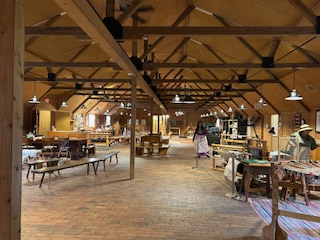
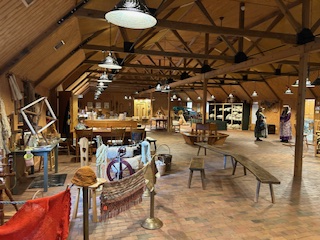
The Family Living Center is located just west of Nauvoo’s Main Street (at White Street)  behind the Cultural Hall and the Scovil Bakery.  It is a very large facility with plenty of room for all of the crafts displayed there.  As in all of Nauvoo, the pioneer skills are demonstrated by missionaries (young sisters and senior missionaries) in period costume.

Sister Hunt and I have often been assigned to serve in the Family Living Center.  We and the other missionaries strive to learn all of the skills.  But we each kind of have our favorite stations.  My own personal favorites are rope, barrel and bread making.

Most folks who come here are surprised at the facility and all that it has to offer.  It is the perfect place for parents to come when their children are tired of all of the more adult tours.  Children love the demonstrations and it is fun to watch the adults as they slowly let their hair down to also enjoy the magnificent place.

The Family Living center is on the “must see” list for many school field trips in the fall and mid-Spring.  School teachers have come to recognize the great opportunity the Center affords their students.

It is interesting that even Google can’t seem to pinpoint when the Family Living Center was constructed.  My own guess is that it was about 2002 – about the same time that the Nauvoo Temple was reconstructed.  The time frame really doesn’t matter.  What matters is that the place is there.

In the busy summer season, there could be as many as a dozen missionaries on duty at the center.  Missionaries enthusiastically greet the many people come.  Folks of all ages come but families with children – young and teens enjoy it most.  Kids love dipping candles as pioneer children and families did in the 1840’s. 

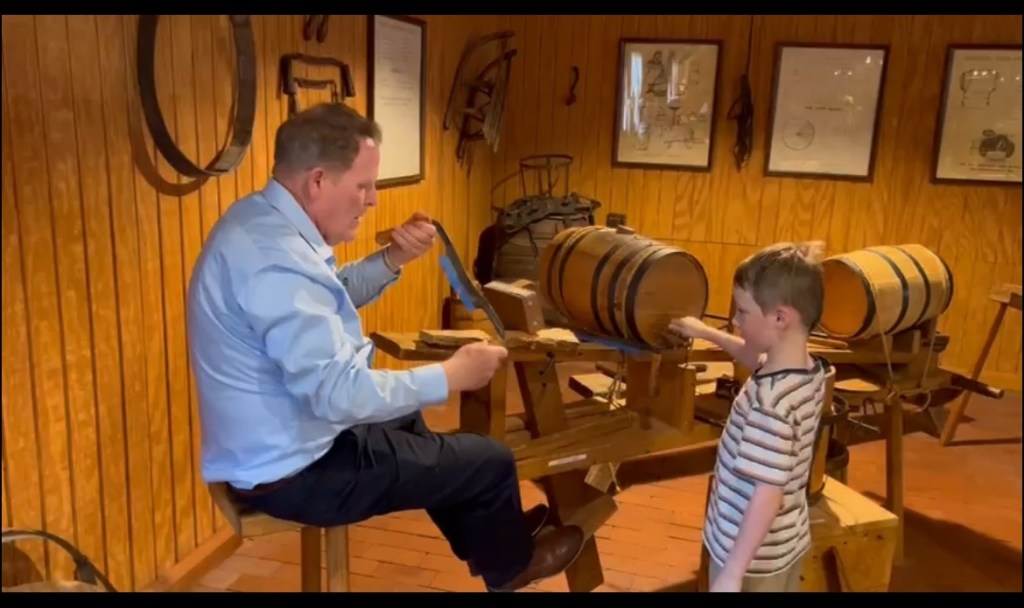
Barrel making or “coopering” is a fun activity for all.  When I teach at this station, I begin by telling folks that to be a journeyman cooper, one needed to be an apprentice for SIX YEARS.  Wow!  I tell my guests that “I am going to teach you all that I know in about five minutes – but you will soon see that there is a lot more to the trade than what I can teach them.

At the beginning of the demo, I say, “Someone famous was a Cooper!” I give the folks a minute to digest this and then say, “Joseph Smith, Sr. was a cooper … so that probably means that young Joseph spent some time in the cooper shop.” People are amazed at this.

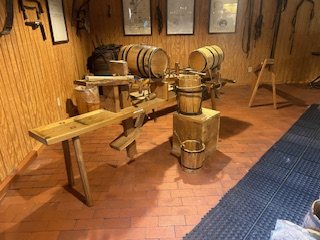
We teach the guests how individual “staves” were created out of long boards that are cut to be about 1” x 16 or 20″ (depending on the barrel size).  Then these staves are formed with both concave and convex angles on each.  The carving is done on a “bench” that is called a “Schnitzel Bank”. (Hmmm … That sounds very German!)

This is kind of like a saw horse.  The person demonstrating sits astride of this bench with their feet pressing against a moveable “pedal”.  And when pressed, this becomes a vice to hold the stave into tight position as it is carved with straight, concave and convex draw knives.

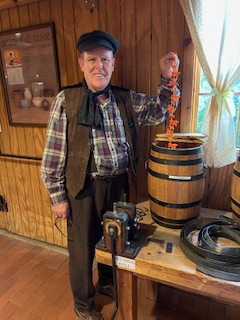
“Tradition” has it that this “Schnitzel bank” came from the old Coolidge House.  Okay … now we are getting somewhere.  As Sister Hunt and I have looked at the bench, it seems clear that this was used by long-time missionaries in the Coolidge House.  My own personal opinion is that it was made by none other than Elder Belcher himself.  (I will have to ask him about it the next time that I see him!)  I then reach into a tall barrel and for the children, I slowly pull out … you guessed it … a string from the old “barrel of monkeys”.  This brings a smile to the adults – who can remember such simple and wonderful games of their youth.  The kids just kind of give me funny looks, “Like, what?”  (You had to be there – 40 years ago … but the “barrel with the monkeys is actually still available in stores.)

Above: Elder Kevin Hunt showing “barrel of monkeys” in the barrel making demonstration in the Nauvoo Family Living Center

Next, I sit the participants two to a bench to put together a barrel.  I say, “You will soon see why it takes two people to do this.”  I then demonstrate the art of barrel making and then turn the folks loose to implement their new skills.  And yes, they too soon learn “why is takes two people” – one to hold the staves up and the other to put them into the metal rings.

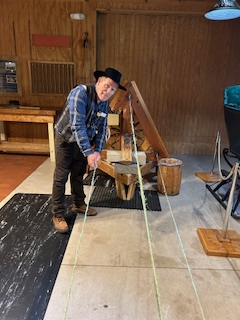
To make rope, six strands of twine are strung between two parts of the apparatus (two strands together strung on a wheel with hooks – on one end – and a twirling gig on the other end.  Participants get to spin this gig at various speeds until the whole “sled’ on the other end – moves about two feet – from one blue tape to the next.

Then once this milestone is reached, the twine on the hooks is secured and the wheel is twirled rapidly by one or two people (usually kids) to twist the now three strands together into one rope.  Again, the “sled has to move another two feet to get fully twisted together.  Then the dads and grandparents get to practice their old Boy Scout skills as they get to whip each ends of the rope (so that it can be cut off of the gig).  Often now, the Boy Scout in the folks has long since departed (especially now since Scouting is not as vibrant – at least in the LDS Church – as it once was).  I enjoy teaching this skill to the dads and then hand them the small string so that they can teach the skill to their kids.  (A teaching skill I learned in my old Scouting Woodbadge courses.)

I have fun with folks at the “packing the wagon” station. 

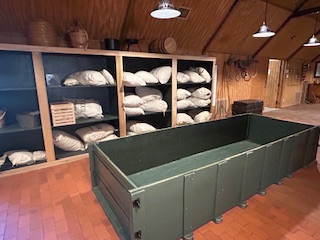
This was not a station in the Coolidge House – but it is fun.  There is a list posted on the wall – called the “Bill of Particulars” and using the list, participants find those items (like 1,000 pounds of flour, etc.) in the adjacent shelves and they pack these items in the wagon for the trek west.  And when the wagon is packed, we invite young and old to join in on a parade around the wagon as they gaily sing, “Pioneer Children sang as they walked, and walked, … and walked.”

I also enjoy teaching bread making – probably in honor of my mother – who made lucious bread two or three days every week for years and years. COVID stopped the making of real bread, but we can still share the mechanics of how it is done – in the old oven. People just have to use their smelling imagination.

Above: Elder Hunt doing bread demonstration

The Pioneers had a challenge to make bread. They had to first start a fire in a nearby fireplace. Fire was also built in the brick oven – to fill it to capacity. The oven would have to be “pre-heated” with the fire until it burned down to coals completely. The coals were then removed from the now hot oven. Corn meal was sprinkled in the oven – and on a large paddle on which the bread dough was placed – so that the dough would not “stick”.

Above: Cooking fireplace at bread making station in Family Living Center

And as the oven was heating, water would be heated on the big fire. Hot water would be placed in a large bowl and this would be placed inside of a wooden “proofing box”. And during all of this, the bread dough would be created. Then a container of dough would be placed in the proofing box along side of the hot water.

AFter ten minutes, the dough would be punched down. And after the second 10 minutes, it would be punched down again and the water bowl would be replaced with more hot water from the fire. The 10 and punch, 10 and punch routine be repeated. The dough would be formed into loaves, rolls, or whatever and then placed in the prepared oven. Quite a process but I am sure that the bread was fabulous!

Once for a mission activity, we actually cooked bread using the above method and it was so great!

Sister Hunt likes to teach candle making and of course, brick making.  At the candle making station, kids enjoy dipping candles into the hot wax to enlarge the candle.  She is also good at the fibers and spinning station.

AN ENDURING LEGACY OF ELDER BELCHER

Well, it is sure amazing to review and remember the ongoing legacy of Elder E. H. and Sister Verna Belcher certainly left their mark on Nauvoo … and in so many ways.

One blessing to me is their daughter who got adopted into the Nauvoo blood.  Now it runs in her veins.
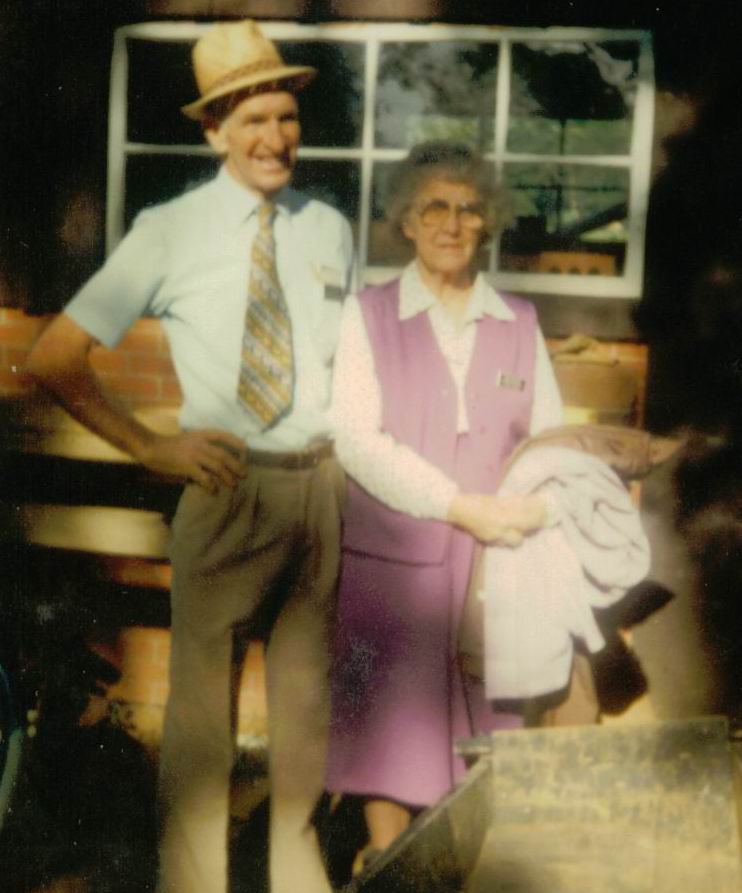
As a review …  They served for two and a half years in the Lucy Mack Smith home.  30 months in one little house!  That alone is unbelievable.  We work in 28 different sites and get moved around to a new house every day.   This means six different homes in a single week.  We love this.

Sister Verna Belcher at the Lucy Mack Smith Home

Then there is the brickyard and the creation of the Nauvoo brick.  He was challenged by the Lucy Mack Smith arrangement and he researched brick making.  Then he created the brick yard – across the street from Lucy’s place.  And soon thereafter, he created the Nauvoo brick.  And this has been a mainstay for all Nauvoo visitors for over 45 years now.

And then there is the Coolidge House.  He literally saved this grand building from destruction.  And in this building, he began demonstrations of various pioneer trade skills.  Those skills were presented for many years in the Coolidge House.  And then 20 or so years later, those same skills were transferred to the new Family Living Center.  The trade demonstrations continue even to this time and generations of guests come there to enjoy them together.

Above: Sister Lou Dene Belcher Hunt and Elder Kevin Hunt in front of the brick kiln built by Elder E H Belcher

His daughter, Lou Dene, my wife, AKA Sister Lou Hunt … is now here in Nauvoo as a senior missionary.  She has been a dedicated advocate in the greatest of the Belcher (and Hunt) tradition.  Great job, Sister Hunt!

So amazing.  We are grateful to this great man and his supportive wife.  They truly did leave a heavy mark and a lasting legacy that will continue on for many more generations.  Thanks, Elder Belcher!

So great to be on the Nauvoo trail behind Elder Belcher.  We have to run to keep up with him.


 [DKB1]

Serving in Nauvoo Homes and Shops

Blog #24

By Kevin V. Hunt

Elder Kevin and Sister Lou Dene Hunt are enjoying serving in Nauvoo homes and shops. We are pleased to be serving in Nauvoo as “Site Missionaries” in the Illinois Historic Sites Mission (that includes Nauvoo and Carthage).  This is a great blessing and privilege.

As noted earlier, Sister Hunt’s parents, Elder E.H. and Sister Verna Belcher served in Nauvoo from 1979 to 1981.  They spent their entire mission (18 months plus 2 6-month extensions) in the tiny Lucy Mack Smith home.  They got to know that tour well.  Also, while here, Elder Belcher built the Nauvoo Brickyard and created the now famous souvenir “Nauvoo Brick”  that is still enjoyed by our guests today.

And you also know that I served in Nauvoo in 1975 for the final six months of my mission – also as a site missionary – just as today.  There were then 8 sites that were open to the public and Elder Hunt knew each of these tours and took people through all of them.

Things are different today.  There are over 30  restored homes and shops in Nauvoo, so visitors have a variety (and quantity) of places to see and experience.

Today Sister Hunt and I get rotated amongst the various homes – daily!  We have the opportunity be in all of the 30 sites and have learned the scripts for each one.  It is a great honor to serve in these sacred Pioneer homes and to share the lives and testimonies of faith of the early Saints who lived in Nauvoo from 1839 to 1846.

This presentation has been prepared to share with our family and friends.  You often hear that “we are in this home (whatever one) today” with little comprehension of what that means.  This document introduces the various homes and shops and tours that are available for guests to see and experience (and feel) here in Old Nauvoo. 

We hope that you will enjoy this brief introduction to the many beautiful places here in Nauvoo.  Perhaps it can help you enjoy Nauvoo from “a distance” until you have opportunity to come to Nauvoo to really experience Nauvoo for yourself.  Come, and bring your families – and know and feel the full beauty, glory, and wonder  that awaits you here.

Here is the link for you to connect to the presentation.

It is so great to be serving on the restored trail of Old Nauvoo …

Elder Kevin Hunt