THE WHISTLING AND WHITTLING BRIGADE
BLOG #23
A while ago, I mentioned in passing about the Nauvoo Whistling and Whittling Brigade. In the earlier blog, I said that I would write about the Brigade in a future blog. And a promise is a promise!
THE WHISTLING WHITTLING BRIGADE IN OLD NAUVOO
Back in pioneer Nauvoo, the Whistling and Whittling Brigade was a thing – a special group – a brotherhood back then.
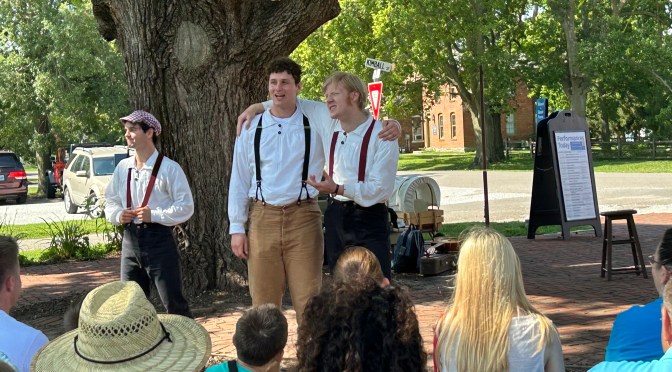
Today, we talk of the group in two of our presentations. One is at the “singing tree” where the Nauvoo Performing Missionaries (NPM’s) perform. There is a giant tree in Nauvoo. It is at the corner of Main Street at Kimball Street. Two or three times a day, the NPM’s sing at this tree, and it is so fun to gather there with whoever might then be on Main Street.

One presentation that we have enjoyed there is “Men Sing the Songs of Zion”. Another popular production is “The Youth of Zion”. In this little vignette, several of the young performers – both men and ladies – talk about the Nauvoo youth and some of their activities, their spirit, etc. I love this presentation. Like all of the other performances, this one is fantastic.
In this presentation, the performing missionaries introduce the Brigade and talk of how the youth of old Nauvoo protected the city with their whittling antics.
The Teamsters also talk about the Brigade as they tell stories out on their Carriage Ride – where folks ride on wagons pulled by horses – and as they go over the woods and through the river north of the Visitors’ Center. Their Depot – where the trip begins, is at the north end of the Center parking lot. The Teamsters tell of one David Moore and give him credit for starting the Brigade. They tell how his boys “whittled and whistled many a rascal right out of town.”

My ears perk up with any hint of some new piece of history for me to latch onto and to study in depth. And the Whistling Whittling Brigade was one of those. I am, of course, a whittler from ancient history – so I was particularly intrigued with this Nauvoo Brigade and their woodcarving. Whitling … now there is something I can relate to.
MY INTEREST IN WHITLING AND CARVING STARTED AS A YOUNG BOY SCOUT
I took up an interest in whittling when I was a Boy Scout – age 12. I had an official Scout knife – and I still have it. It is black and kind of “bulky” for a knife. (Not as sleek as later models.) I took the Woodcarving merit badge at Camp Geronimo. I earned the badge by carving a letter opener and a neckerchief of the hand of a Scout in the Scout sign. I still have the pocket knife and the letter opener. I cannot find the Scout sign, but I know that I must have it – since I never throw away “anything historical”. (I have quite a collection!) The two wood-carved pieces are not at all marvelous, but they do bring back special memories.
MY FIRST CARVED WALKING STICK
My woodcarving skills were put on hold for many years. I didn’t know that I had any skills – or even interest. Then I got involved with the Boy Scouts in a more professional way. And it was then that the dormant interest began to stir once again.
As a new professional for the Boy Scouts of America, I found myself on a 24 or so day training back at the old Schiff Scout Reservation in New Jersey. (This place was magnificent but has since gone the way of the world – sold to help pay for other Scouting opportunities). I attended what was then called “NEI” – which is the acronym for “National Executive Institute”. While at the NEI training, I went to the little bookstore that they had at the place. And I there purchased my first real Scout whittling knife. Wanting to carve, but not knowing what to carve, I found a stick and began to carve on it.
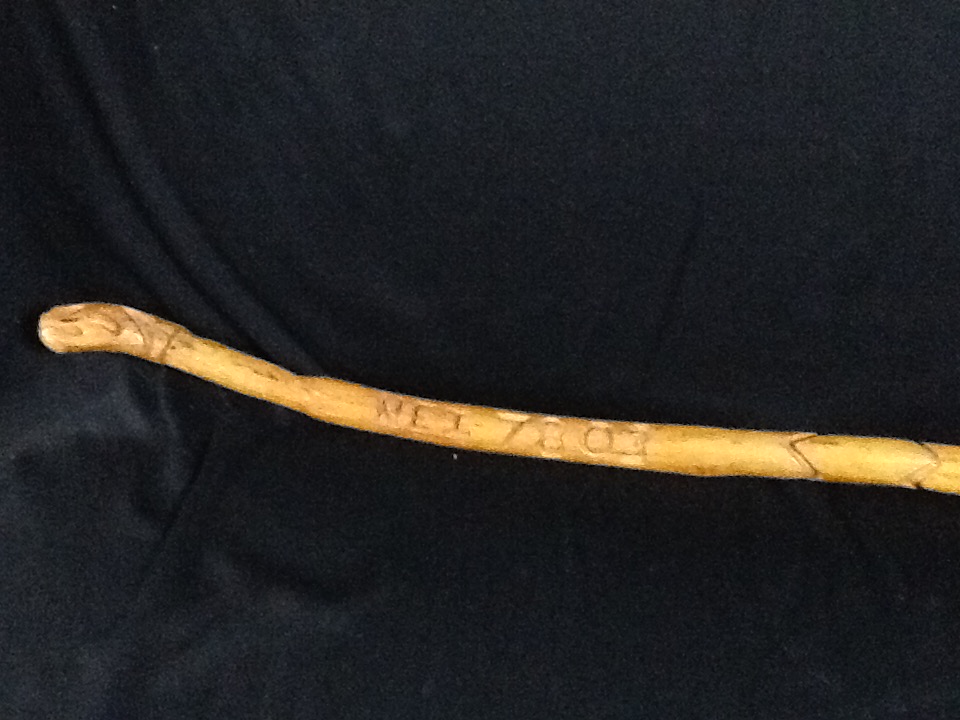
I carved “NEI” on it and took advantage of the natural curves and bumps of the stick to create a twisted funny face. Also on the stick, I carved “NEI 7803”. (I was in the 3rd NEI Class of 1978 …). I quickly learned that all one needs in order to whittle was to get a knife and a stick – and to go at it. I found that was true. It began to work for me. Again, it was kind of a humble start, but it was enough to get me hooked on the skill or hobby or whatever it was.
In the rush of leaving for home, I somehow left my newly carved stick at the NEI place in New Jersey. And then I was in a dilemma. I called back to folks at the Reservation, and they found the stick and the folks were able to send it home with a BYU friend who was in the 7804 NEI class. It took a few months before I had a rendezvous with Brad to get the stick back. I was grateful that he took it on the airplane and somehow got it back to me.
Carving that stick got me hooked on the practice and art of woodcarving. I resolved then that I would create a new walking stick for each Boy Scout camp that I would work at in the future. And, so, a new tradition was begun. I created a stick at and for Camp Loll where I worked later that summer. And then later, at Camp Bartlett, I created a new stick for that camp. And so, it began – and became a thing for me. I got into the mode of finding the right wood stick and with just my trusty Scout carving knife, I began to have success. I worked hard to create the new sticks through the years. And I had a great time doing it.
Creating the sticks was sometimes a challenge when the pressures of time and responsibility sometimes were so much that I didn’t have as much time to carve as I desired.
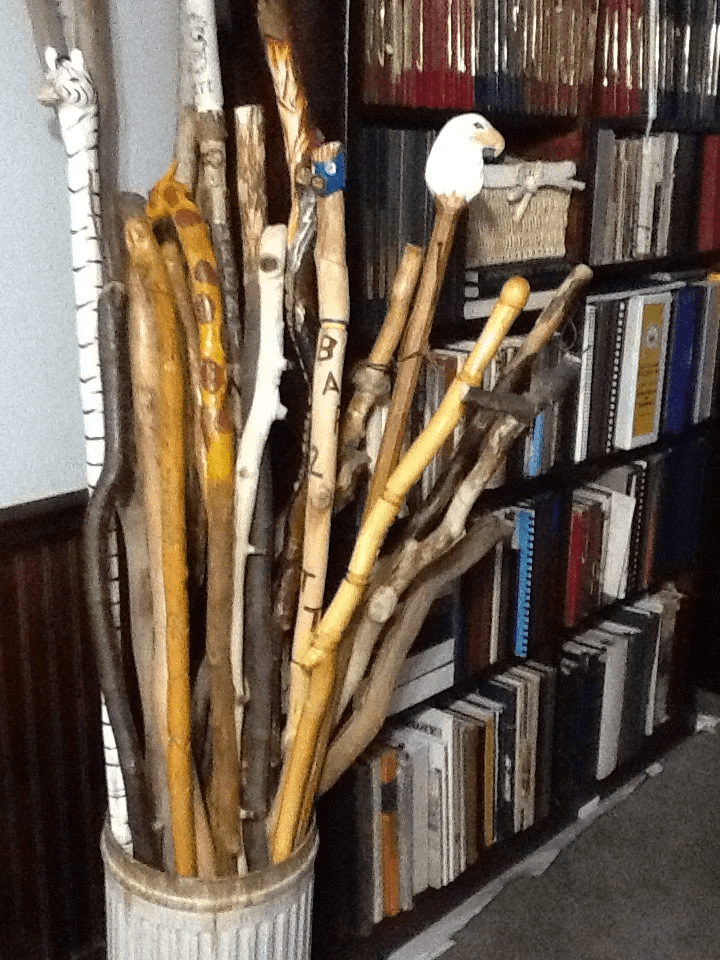
Over the passage of time, I created about 15 new walking sticks, and I have them in a barrel collection in my Scouting Trails Museum – now jam-packed floor to ceiling at our Maricopa home. We moved all extraneous stuff of Sister Hunt and me into our two front bedrooms to make room for our daughter and son-in-law who are residing in our place while we are on our mission. I filled one room (my museum) with my stuff and Lou filled the front bedroom with her stuff.
WALKING STICK COUNSELING
I found that carving the sticks at camps afforded me a unique experience. I called it my “walking stick counseling”. I could go sit literally anywhere in camp – even on some remote log on some hidden trail. I would start carving and within a few minutes, I would have a couple of Scouts there on the log with me. They were very intrigued with my carving and asked many questions as I showed them what I was doing.
We had great conversations. And as I sat with the boys on the log with me, I would ask them about camp. “How do you like the Nature area? What is your favorite thing to get at the trading post? Who is your favorite staff member? Do you see any problems with our camp?” And in these discussions, I learned about the goings on all around the camp. Then as needed, I could use what I had learned in future staff meetings or discussions with individual staff members.
By this method, I seemed to know everything that was going on around the camp. And this blew the minds of my staff. They wondered how I knew all of this about them, and their areas, and the camp. It was great!
THE POCKET KNIFE SAGA
I mentioned that first BSA whittling knife. I carried that knife in my pocket always for about 20 years. I had used this knife to carve many of my stick in the collection. Then, one summer, we took all of the kids up north to the town of Payson, Arizona and attended July 4th festivities there. We sat in the grass at a large park to watch the fireworks. Then sadly, the next morning, I realized with horror that I no longer had my pocketknife. We returned to the park, and we all scoured the area around where we were sitting – but to no avail. The pocketknife was nowhere to be found. (I am sure that someone else found it and enjoyed it.)
Soon thereafter, and knowing of my love for the knife, my three sons pooled their resources, and they bought me a new knife – identical to the original BSA carving knife. That was about 25 years ago, and I have since carried that knife everywhere as I had its predecessor. And, like it, I have now carved many more sticks with it. And I still (even on the mission) carry that knife with me everywhere (except church – where I’ve learned that it slips out of my suit pants pocket). And I also carry my dad’s “Old Timer” knife with me – keeping a part of him with me as I serve. (And there’s another “Old Timer” story … which I have already long since blogged about.)

MY OBSESSION WITH BOLO TIES
With my whittling interest, I have had a life-long obsession with a love of hand-carved bolo ties. Though I have never carved one, these have become my personal trademark. I have so loved them, that there have been few days over the years when I have not worn the carved ornaments around my neck. Even family photos through the years each sported a different bolo time (for posterity).
My bolo tie interest also had its beginnings in my youth. When about age 16, I read in the “Scouting” magazine about the famed woodcarver, Bill Burch. I read of him creating hundreds of the bolos and then giving them out to Scouts at the National Scout Jamboree. (And that is also when I first learned about Jamborees and developed an intense desire to take our Troop 155 to the upcoming 1973 Jamboree (and that is a story that I’ve already told).
Anyway, from that youth moment, I wanted to somehow acquire a Bill Burch Bolo Tie (or “neckerchief slide”) but didn’t know how to get one. This aching burned within me for several years. Then finally when I was about age 30, a Bill Burch bolo came to me.
Lou and I and three children (expecting #4) were then living in Santa Barbara, California (where I was still a professional with the Boy Scouts). I was also the Ward Mission Leader. We literally had absolutely no place to house our missionaries. (Santa Barbara is a wonderful and most beautiful place – but it is also very strange relative to housing for young adults and families.)
Lou and were already crowded in our 3-bedroom townhouse with our expanding family but we moved all of the children into one bedroom. We then created bunk beds and furniture in the other bedroom to accommodate young Elders to be with us.
One of the first missionaries who came to live with us was from Spokane, Washington – where I knew the carver, Bill Burch, lived. I got excited. I said to him, “Do you know Bill Burch, the Scout carving guy?” He said, “Yeah, he was my Scoutmaster.” I said, “Really …! Wow! I have forever wanted to have one of his famous bolo ties.” He said, “I have about seven of them in my dresser at home. I will have my mom send one of them to me.”
He did so … and that is how I got my first Burch bolo … numbered #6667 on the back. And that started an even greater obsession with them. The bolo had the address of Bill Burch on the back – with the number of the bolo. And with his address, I was able to communicate directly with him to acquire additional of his bolo ties.

Photo: Kevin Hunt (left with walking sticks and friends – at his 50th Anniversary in Scouting Jubilee Celebration
From that point forward, I have collected bolos from many sources and from more than a dozen different carvers of them. And now, I have a collection of about 35 of them – with the goal of having one to pass on (posthumously) to each to my nine children (including the ladies) as well as one for each of my 26 grandsons. It has taken a bit of effort and resources to accumulate such a collection. (And that brings to memory another blog article …) Read it at: https://thescoutingtrail.wordpress.com/2017/10/23/bolo-ties-are-part-of-my-scouting-tradition-part-1/
BLOGS, BOYS, KNIVES, STICKS, AND WHITTLING
Some years ago, a long-time Scouting friend, Darryl Alder, got me hooked on the hobby or whatever it is – of writing blog articles. I’ve written about a 100 blog articles on Scouting subjects and many of them through the years have been on woodcarving, or whittling,
I introduced one of those blogs saying, “There is something about boys, knives, and carving … Like kids and mud puddles, camp, Scouts, sticks, and knives just kind of go together. One thing that all Scouts seem to have in common is their propensity for stick carving.” (August 16, 2017)
Sadly, with the passage of time and the changing of the guard in Scouting (and me personally), many of the links to those former great articles have gone the way of the world. But I did save them and published them all in Volume #20 of my personal autobiography (that I called “My Life’s Collective Works”). You can access the book at this link:
NOW BACK TO THE NAUVOO WHISTLING WHITTLING BRIGADE
That was kind of a round-about way to introduce the Nauvoo Whistling Whittling Brigade. I hope that you enjoyed the detour …
So, boys, sticks and carving are not a new phenomenon. The connection is probably as old as time. Adam and his sons probably made knives and began carving soon after the Eden experience. It was likely a part of their survival mode.
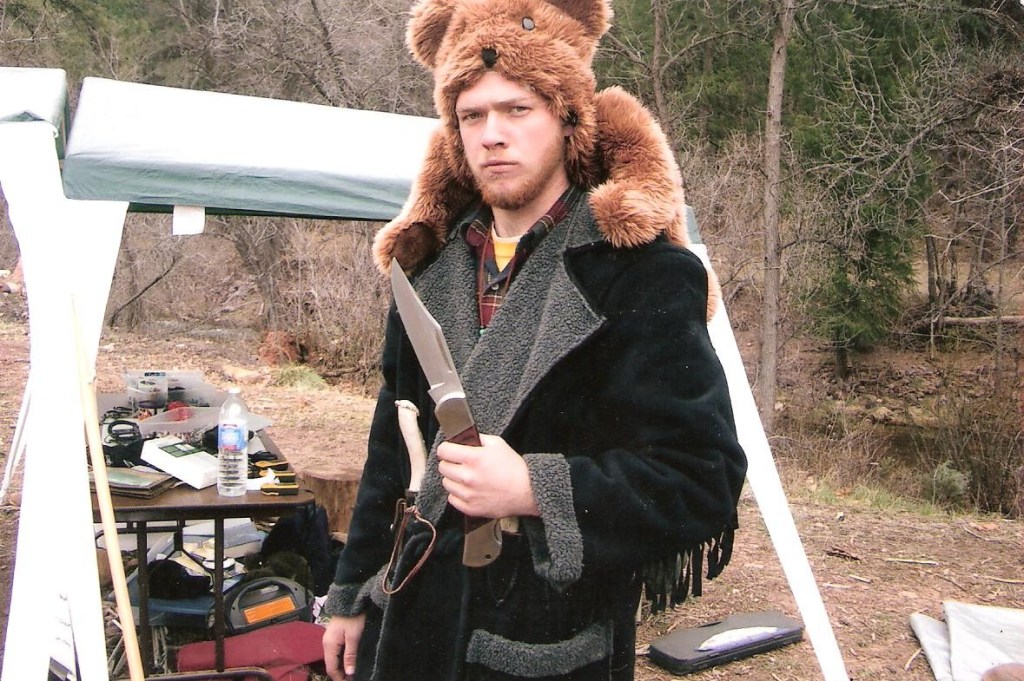
When my sons were teens, they were privileged to attend the biennial Varsity Scouting “Mountain Man Rendezvous” held at Camp Geronimo near Payson, Arizona. In preparation for this grand guy event, the boys worked for months ahead to create capotes (large fur-like capes) mountain man hats, and other gear. Creating their own knife (from a plain piece of steel to a cool, finished knife) was a part of the program. And each Scout who made such a knife has, no doubt, treasured it for life since that time. (*Much to the dismay of their wives who wonder why their men keep such a thing in their homes.)
HISTORICAL BEGINNINGS OF WHITTLING AND WHISTLING IN OLD NAUVOO
Historical records indicate that the old Nauvoo Whistling Whittling Brigade likely did not get its formal start until 1845 – after the death of the Prophet Joseph
. However, Mosiah Lyman Hancock may have employed the same tactics much earlier – to help protect the Prophet Joseph Smith. Mosiah was born in 1834 so would have been ten years old when the Prophet was martyred. He was the son of Levi Ward Hancock (and nephew of my 4th great grandmother, Clarissa Hancock Alger). In his autobiography, he said,
“I joined the whistling and whittling band. In those days, there was, now and then, a fop or dude who would go to a man’s shingle pile, and with his hat or cap cocked on one side, would sit and whittle and whistle. There was no law against that, but from what we could learn, some of them were interested in taking the life of the Prophet. We kept a good watch and were directed to keep an eye on the “Black Ducks”. We really tried to do our duty, and we succeeded in bagging some game. I was about to give some instances, but forbear by saying, “In no case did I ever help to engage in whittling any one down to make them cross the great river unless they were known to be lurking around the Prophet’s premises quite late, or to be seeking that which was none of their business. In extreme cases when we knew a man to be a snobber, and who still sought the life of the Prophet, we would use our rail. We generally had four boys to a rail—–the rail would be flat on the bottom and was three cornered; on the top corner it was terribly sharp—–fixed to suit the aggravating circumstances. Four boys generally knew how to manage the rail. We all had our knives and our timbers to whittle and make rails from, and we knew what tunes to whistle. I do not know if the boys from Nauvoo would like for me to betray those old-fashioned secrets; but that was the way we initiated those who seemed to wish with all their hearts to become thoroughly acquainted with the secrets of the Prophet. …”
Source: (https://doctrineandcovenantscentral.org/history/mosiah-lyman-hancock/)
The above account tells of how Mosiah (who lived just a block East of Joseph’s Mansion House – on the corner of Water and Partridge Streets) helped to protect the Prophet Joseph. Mosiah continued: “The Brethren pushed the work on the Temple; and the Gospel was preached; and every Saint was busy doing all he could to help the work along. Although I was very young, I was on guard many a night, and gladly did I hail with many of the Saints, the completion of the temple.”
Mosiah adds an interesting side note: “On about January 10, 1846 [when he was 12] , I was privileged to go in the temple and receive my washings and anointings. I was sealed to a lovely young girl named Mary, who was about my age, but it was with the understanding that we were not to live together as man and wife until we were 16 years of age. The reason that some were sealed so young was because we knew that we would have to go West and wait many a long time for another temple.”
As noted, Mosiah seemed to be protecting the Prophet Joseph (who died in 1844). The real organization of the Brigade happened after the death of Joseph but Mosiah had the skills so he definitely would have fit right into the newly organized Brigade.
PROTECTION FROM THE MOBS
From the day of the First Vision, Joseph the Prophet of the Restoration, had to run for his life. He was constantly barraged by evil people who wanted his capture or even his demise. He had to be constantly on-guard and had to ask many other people for their help and protection in his behalf.
The enemies of Joseph and Hyrum thought that the church would evaporate or die with the martyrdom of Joseph and Hyrum. The harassment of the church stopped but only for a brief period before it intensified even more. The evil designs of the adversary opened fire against the Saints. Foes of the church were also determined to stop the construction of the Temple.
THE NAUVOO CITY CHARTER

“The Nauvoo City Charter was unique because it established a city council, municipal court, university, and independent militia unit (“The Nauvoo Legion”). The charter was quickly approved by the Illinois general assembly on December 16, 1840, and passed the final review by the Council of Revision on December 17, It became effective February 1, 1841. Before the 1870 Illinois Constitution, municipalities could vote to incorporate themselves or could be incorporated by special acts of the General Assembly. For a time, this city charter was magnificent. It served the Saints well and allowed them to create their own “Utopia” by which they governed themselves.
“The charter authorized the creation of a city council, consisting initially of a mayor, four aldermen, and nine council members; and a municipal court with jurisdiction over local cases and the power to issue writs of habeas corpus. The charter also included provisions for a university and a local militia. … The Nauvoo Legion, the city’s militia – and a local police force – was organized in 1841 and functioned until its charter was repealed in 1845. The Legion was made up of mostly members of The Church of Jesus Christ of Latter-day Saints. Some opponents of the Legion believed it was a threat to non-Mormons.
“ ,,, Nauvoo’s charter was unique among Illinois city charters, the combination of powers in the charter and the energetic use of those powers became a source of contention.”
https://www.josephsmithpapers.org/topic/nauvoo-charter
INCREASING THREAT OF MOB VIOLENCE
Neighboring communities saw Nauvoo and its charter a political and economic threat and mob violence increased.
After the Martyrdom, mob rule was the order of the day. Violence increased as mobs and wicked people continued to want to exterminate the “Mormons” (members of The Church of Jesus Christ of Latter-day Saints) – just as they had done in Missouri and elsewhere prior to the Nauvoo era.
Ultimately, the full charter – with all of its powers – including the right of citizens to defend themselves was revoked in 1845, again by order of the Illinois General Assembly. In January 1845, the legislature repealed the Nauvoo Charter by a vote of 25-14 in the Senate and 75-31 in the House.[2] Nauvoo was dis-incorporated and its assets were placed into a receivership. (https://en.wikipedia.org/wiki/Nauvoo_City_Council)
EFFECT OF THE REVOCATION OF THE NAUVOO CHARTER
The revocation of the Nauvoo City Charter dissolved the Nauvoo Legion as well as the local police force. This action came as mob violence and prejudice continued to increase exponentially. The city was then totally without protection. The Saints were left to the mercy of those opposed to them. Dramatic action was needed for the protection of the city and for the completion of the Temple. Brigham Young and the Apostles soon realized that guards were needed both day and night.
Thurmon Dean Moody wrote a beautiful treatise (maybe one of the greatest writings) on the subject of the Whittling Whistling Brigade. I recommend his article can be found at chrome-extension://efaidnbmnnnibpcajpcglclefindmkaj/https://scholarsarchive.byu.edu/cgi/viewcontent.cgi?article=1738&context=byusq
Citizens of Nauvoo knew that this was the demise of their beloved Nauvoo. Appeal attempts were made but to no avail.
Almon Babbit wrote an appeal to the charter revocation: “Repeal the charter of Nauvoo, prescribe her citizens by your public acts and you will tolerate and encourage the demonstration of mob violence that surrounds the people of Nauvoo.” He noted that fiends around them were waiting to feast upon the Saints to their destruction.
Wandle Mace said of the evil forces: “They tried every means they could devise to bring trouble upon Nauvoo. Frequently a party would land from a steamboat and come into the city, commit their deviltry, and return to the boat and leave again – well knowing we had no law to protect us since the city charter was taken away.”
A PLAN IS DEVISED
Apostle Brigham Young decided that action needed to be taken. On Sunday, March 16, 1845, Brigham called a meeting for the next evening. He said, “We want the bishops at the Masonic Hall, and we will organize them according to our notion of things. We have no police, and the legislature has repealed our charter. We mean to have the City of Joseph organized so the streets shall be kept clear and the poor cared for.”
Hosea Stout had previously been the Chief of Police under the city charter.

Photo: Hosea Stout
The committee organized the city into companies of ten with a captain at the head of each company. The “new police” were to continue to meet mostly as a guard for the Temple. They were not a city organization, but it was to be an ecclesiastical guard. The groups were to receive no pay and were to be volunteers. Not wanting to resort to extra legal extra activities and being aware that their priesthood authority did not apply to any but their own people they felt as if this would be a viable solution.
At the meeting Brigham called, Hosea was present and suggested a plan. He had met three days before with Stephen Markham, a captain in the former Legion. Both were anxious to preserve order as much as possible under the circumstances.
The plan was to organize the whole community of saints into quorums of 12 Deacons – each with a Bishop at their head. David Moore – referred to on the horse “Carriage Ride” said, “The purpose of the organization was two-fold: 1) to take care of the poor 2) to guard the city at night to keep everything straight.” He further recorded: I was appointed one of the bishops also (at age 26). I had a very large district assigned to me. I was allowed 13 men, and we had to keep watch over the north part of the city one night each week including the steamboat landing. Our weapons were a large hickory cane and a toothpick – a huge knife. The object of the knife was to whittle rascals out of town.”
Brigham soon proclaimed this as a new “official Mormon practice” at the meeting on the 17th of March.
IMPLEMENTING THE PLAN
In his autobiography, George W. Bean recorded, “This was my first real public service at the age of fourteen and a half years [and] being large of stature and well equipped, I did my full share of duty for five days and nights after this. I performed guard duty at nights all winter about the streets of Nauvoo.”
On each corner was a man from twelve to twenty years of age who watched all movements from sunset to dawn and reported any suspicious activity to the bishop who promptly consulted the leaders and the Nauvoo Legion Officials.”
THE AGE OF THE BRIGADE DEACONS
Some reports of the Whistling Whitling Brigade indicate that the “Deacons” were all very young – like teen-age boys. Such may not have always been the case. In those days, there was no age parameter for being a Deacon. A Deacon could be a young boy, or he could be an adult. Ages for Aaronic Priesthood quorum membership did not happen until 1908 (just in time for the 1910 organization of the Boy Scouts of America). At that time, young men of age 12 could be ordained as Deacons.
So, the Brigade Deacons could have been ages 12 to 25 or older in old Nauvoo.
THE JOB OF THE WHISTLING WHITTLING BRIGADE
Paul D. Bailey gave a detailed account saying that the community “met the increasing flood of gentile undesirables by organizing the boy population into a whistling and whittling brigade suspicious strangers immediately would be surrounded by groups of boys armed with long bladed jack knives and sticks whichever way the suspect moved the boys followed whistling and whittling as they went. Not a question would they ask not a question would they answer. They were too small to strike individually too many to battle collectively when they descended on a hapless stranger they hugged his presence like vermin until in exasperation he was glad to take hasty leave from the abode of the saints.”
Wandle Mace said, “Our families were exposed to the rascals who on finding them unprotected by husbands and fathers would insult and abuse them in consequence of such things. The old police formed themselves into whittling companies and guarded the city from the rascals. When a stranger came into the city they would learn if they were upon legitimate business and if so, they did not interfere with them but if they had no legitimate business, they were then under the surveillance of the Whittlers who would follow wherever they went whittling and whistling. They did not molest them in any way not even talking to them but simply followed them whittling and whistling as they went.”
William B Pace painted a vivid picture as he wrote in his journal of the activities of the Brigade. He said, that “every boy generally could whistle and most of them had knives from ten to fourteen inches long in scabbards ”a la bouy” and when any of these fellows became boisterous or showed any signs of meddling the boy who discovered would draw his knife and commence whittling and soon a crowd of his pals gathered. Then they would surround the obnoxious element – be he large or small – many or few – and whistled and whittled in his direction and they’d stick by him until he was out of town. This was rather an amusing process. Not a word was said but an unearthly whistle – and generally everyone had his own favorite tune – and an incessant whittling with those large knives was enough to strike terror to the hearts of the victims and he got out of town as quick as his legs could carry him.”
BROTHER BRIGHAM AND THE BRIGADE
Brigham Young was often confronted about the Brigade by men who got whistled and whittled. He denied that he had anything to do with the antics of the Brigade. But, on 14 April 1845, during the height of the brigade encounter, Brigham Young mentioned that “Nauvoo’s Whistling and Whittling Brigade and the deacons have become very efficient looking after the welfare of the saints. Every part of the city is watched with the strictest care and whatever time of night the streets are traveled at the corner of every block a deacon is found attending his duty.”
Dirty men who felt the brunt of the Brigade sometimes complained to Brother Brigham and accused him of orchestrating the plan and the antics of the Brigade. One such person who talked to Brigham was given an interesting retort back. President Young is reported to have quietly replied in the words of Martin Van Buren when president of the United States to Joseph Smith: “Gentlemen your cause is just but I can do nothing for you. The legislature has taken away our city charter we have no laws nor power to protect you.”
Obviously, Brigham Young did support the Bishop and Deacon method of watching and guarding Nauvoo, but it was not as apparent that he was supportive of what appears to be its offshoot the Whistling and Whittling brigade.
Many reflected the opinions expressed by many involved with the organization noting that the Brigade lasted but a few weeks. But, even so, Scoundrels soon learned that to go into Nauvoo, men must mind their own business and not meddle with the people, or they would get whistled out. So, if the whistlers kept out even a few of the bad guys – the scoundrels – they were successful.
While the Whistling Whittling Brigade was successful in the short run, the Bishops and Deacons ultimately could not fully control the mobocrats who came after the Saints. They were still expelled from Nauvoo – beginning in February of 1846.
SO, WHAT DID THE WHISTLING WHITTLING BRIGADE WHITTLE?
This blog article was based on the assumption that the Whistling Whittling Brigade actually did real “woodcarving” – and that the Bishops and Deacons created a desired object, shape or design with their sharp-edged cutting tools. (That is a Google definition.) I guess I assumed that the work of the Whistling Whittling Brigade was whittling or actually wood carving. And this is what drew me to the Nauvoo Whistling Whittling Brigade.
Now, however, as I have learned more about them, I have realized that their real purpose was to protect the city and to encourage scoundrels to get out of town fast. I realized that they really weren’t doing real woodcarving, but they sure put on a good act. They cut on sticks as if whittling – but probably were just taking big swipes (maybe taking the bark off of their sticks). I had no idea that they did their whittling with large “Bowie Knives”. Whittling really is not possible with a very large-bladed knife. Whittling – with a specific goal or design in mind – is best done with small blades that can be manipulated to create intricate designs.
WHAT DID THE WHISTLING WHITTLING BRIGADE ACCOMPLISH?
I learned that the Brigade really was successful – in that they accomplished their goals – but it was a different goal than I had supposed. Their mission was that of helping scoundrels out of town. They were a real source of strength to the Saints. Their presence helped Saints feel at least some peace and protection – even in the trauma of the time. Their work had nothing to do with whittling and carving. Theirs was a higher calling – to protect their community, the Temple and fellow saints. And they accomplished that mission.
The Brigade members served their Nauvoo Covenant Community. Each man or boy did his best and did his part to contribute to the community as a whole. Brigade participants experienced a great brotherhood as they worked and served together. They became friends, and brothers as they served together for the cause of Zion.
Brigade members worked under the direction of their ecclesiastical or church leaders. They were a beautiful witness of how the Priesthood can operate when all work together. Bishops were responsible for and guided their Deacons – men and boys – in the protection of their fellow Saints. Bishops and Deacons worked together to accomplish their mission – setting an example of how Bishops and Aaronic Priesthood men and boys can work together in our day.
The Brigade was successful in keeping the peace in the short run but, the Brigade could not handle the violent mobs that were to come, and the Saints were later forced to evacuate Nauvoo the following spring. The Spirit and camaraderie of the Brigade members, however, would live on within their minds and hearts as they went forward – united in faith – to their next adventures and future priesthood responsibilities.
I am surely not a whistler, but I do love to whittle along the trail whenever I can.
Kevin V. Hunt
 On the Nauvoo Trail