By Kevin V. Hunt
Blog #22
“The Book of the Law of the Lord”. Wow! What an intriguing title! It gets one thinking, doesn’t it?
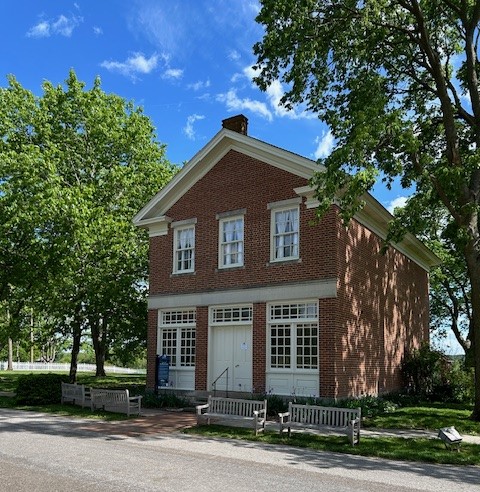
One of my favorite tours as a site missionary here in Nauvoo is that of Joseph Smith’s Red Brick Store. We tell our guests at the beginning of our tours there, “This is a special and sacred place because of the many great and sacred things that occurred here in Old Nauvoo.”
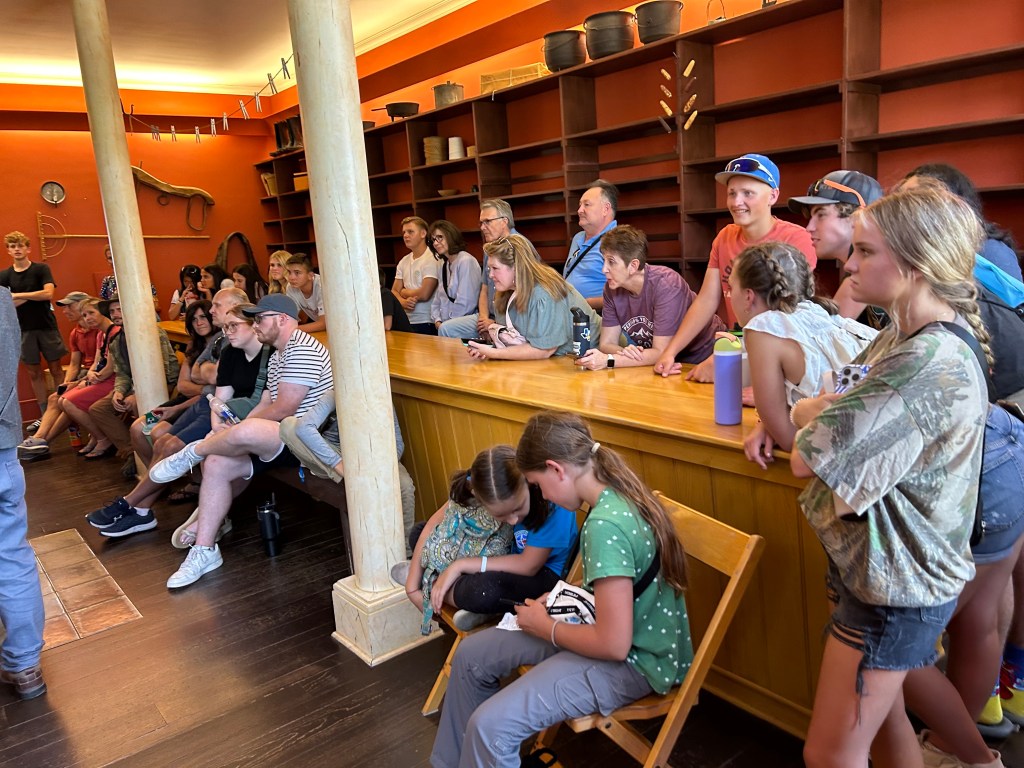
After giving a brief review of the history of the building, and how excited Joseph Smith was as he opened the store in January of 1842, we tell folks that “the Prophet Joseph was not much of a storekeeper. He was too kind. He gave everything away on “credit” to those in need.” We then say that “he turned the store operation over to his clerks, Willard Richard and Newel K. Whitney – and that improved the “bottom line” considerably.” We then say that “Joseph had a much holier calling and more important things to do than to be a store clerk.”
We also say, “And the Red Brick Store also had a much holier function than just being a store.” I like to point out the little square window at the back wall. And as I do, I say that “the clerks did normal store stuff – sales, receipts, etc., at that window, but they also did more important and sacred functions there.”

That holier store function was where Apostle Willard Richards accepted sacred donations for the Temple and the Nauvoo House construction – as well as tithing funds of the Church.
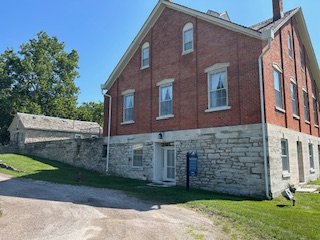
At Joseph Smith’s “Homestead” (where he and Emma and family lived from May 1839 to August 1843),

Joseph received the revelation of Section 124 of the Doctrine and Covenants. Verse 23 introduces the “Nauvoo House” and says that it is to be a “boarding house, [where] strangers may come from afar to lodge therein; … that the weary traveler may find health and safety while he shall contemplate the word of the Lord … and the glory of Zion, and the glory of this, the cornerstone thereof.” (D&C 124:24, 60). I love that! And the revelation continues: “Let no man pay stock to the quorum of the Nauvoo House unless he shall be a believer in the Book of Mormon, and the revelations I have given unto you, saith the Lord Your God.” (D&C 124: 119)
The same Section 124, also introduces the need to build [a new] Temple, “that [I, the Lord] may come to and restore again that which was lost unto you, or which he hath taken away, even the fulness of the Priesthood … and I command you, all ye my saints, to build a house unto me; … And verity I say unto you, let this house be built unto my name, that I may reveal mine ordinances therein unto my people. … And if ye labor with all your might, I will consecrate that spot that it shall be made holy. … And again, verily I say unto you, I command you again to build a house to my name … that ye may prove yourselves unto me that ye are faithful in all things whatsoever I command you, that I may bless you, and crown you with honor, immortality, and eternal life.” (D&C 124:40, 44, 55)

The Lord further stated that stock in the two buildings was to be sold, and Church members were invited to become “stockholders”.
On July 6, 1838, The Lord gave the revelation of Section 118. Joseph had prayed, “O Lord! Show unto thy servants how much thou requires of the properties of thy people for a tithing”. The introduction to this section says, “The law of tithing, as understood today, had not been given to the Church previous to this revelation. The term tithing in the prayer just quoted and in previous revelations (64:23, 85:3, 97:11) had meant not just one-tenth, but all free-will offerings, or contributions to the Church funds.”
In the revelation, it states, “Verily, thus saith the Lord, I require all their surplus property to be put into the hands of the bishop of my church in Zion. For the building of mine house, and for the laying of the foundation of Zion and for the priesthood … And this shall be the beginning of the tithing of my people. And after that, those who have thus been tithed shall pay one-tenth of all their interest annually, and this shall be a standing law unto them forever, for my holy priesthood, saith the Lord … [and] all those who gather unto the land of Zion shall be tithed of their surplus properties and shall observe this law, or they shall not be found worthy to abide among you.” (D&C 119: 1-5)
The Law of Tithing had been taught anciently by the Prophet, Malachi. His prophesies are recorded in the final book of the Old Testament. In Malachi 3:8-10, The Lord himself asked, “Will a man rob God? Yet ye have robbed me. But ye say, Wherein have we robbed thee? In tithes and offerings. Ye are cursed with a curse: for ye have robbed me, even this whole nation. Bring ye all the tithes into the storehouse, that they may be meat in mine house, and prove me now herewith, saith the Lord of hosts, if I will not open you the windows of heaven, and pour you out a blessing, that there shall not be room enough to receive it.”
These teachings of Malachi were given some 400 years before the coming of Christ. The New Testament has several references to the payment and receipt of tithes.
The Nephites left Jerusalem about 600 BC. This was about 200 years before the time of Malachi. They took with them “the brass plates” that had been kept by Laban and his progenitors. The Plates contained prophesies roughly up through the Old Testament Prophet Jeremiah. Obviously, they would not have had the teachings of Malachi.
It is significant that “when the risen Lord appeared to the faithful on this continent, he taught them the commandments the prophet Malachi had already given to other children of Israel. (Elder Dallin H. Oaks.) The Lord commanded that they should record and teach [the words of Malachi – as quoted above. It is also very interesting that after the Savior quoted these words, he told the people that God the Father had commanded him (Jesus) to give these words unto the people assembled. Wow! Talk about important! Consider the source!
And again, quoting Elder Oaks, “Here we see that the law of tithing is not a remote Old Testament practice, but a commandment directly from the Savior to the people of our day. The Lord reaffirmed that law in modern revelation, commanding his people to pay “one-tenth of all their interest …” (Again quoting D&C 119:4)
Elder Oaks quoted President Heber J. Grant who said, “I appeal to the Latter-day Saints to be honest with the Lord and I promise them that peace, prosperity and financial success will attend those who are honest with our Heavenly Father. When we set our hearts upon the things of this world and fail to be strictly honest with the Lord we do not grow in the light and power and strength of the gospel as we otherwise would do.”
Elder Oaks further said, “Tithing is a commandment with a promise. The words of Malachi, reaffirmed by the Savior, promise those who bring their tithes into the storehouse that the Lord will open “the windows of heaven, and pour [them] out a blessing, that there shall not be room enough to receive it. … The payment of tithing also brings the individual tithe payer unique spiritual blessings. … We pay tithing as the Savior taught, by bringing the tithes “into the storehouse”. Elder Oaks continued, “In earlier times, tithing was paid in kind – a tenth of the herdsman’s increase, a tenth of the farmer’s produce. I am sorry that our modern cash economy deprives parents of the wonderful teaching opportunities presented by the payment of tithing in kind.” (Elder Dallin H. Oaks, April 1994 General Conference)
I can definitely testify of the blessings of paying tithing and fast offerings in my life – and that of our family. We have never professed to have any money in our family as Lou and I raised our 9 children but … we faithfully paid a full tithing (on the gross) of every paycheck that we ever received. And we paid a substantial fast offering with each pay check, as well.
We were unemployed on several occasions, and we were often stressed financially but we were truly blessed. We lived on faith and in that faith, the Lord definitely came through for us – as promised by Malachi – and Jesus, and we experienced the opening of the “windows of heaven” in our behalf. And I note that generally, the windows were fully opened so that we got the full “draft”. These blessings were poured out upon us because of our faith and the tithing and fast offerings that we paid. The Lord always provided for us, and we never lacked. I believe that. I know that!
* * * * * * * * * * * * * * * * * * * * * * * * * * * * *
The saints in the days of Nauvoo welcomed the teaching of Joseph Smith, their prophet, as he continued to teach and encourage all (no matter how poor) to continue to pay their tithes and offering for the construction of the Temple and as tithing, generally.
And that brings us back to Joseph’s Red Brick Store, and the clerks of the Church. As Willard and Newell received the sacred funds, and contributions of all kinds, they recorded these in what they called “The Book of the Law of the Lord”.

I have been intrigued by this book and its title since I first learned of it (and have taught about it in Joseph’s Red Brick Store). It has been fun to teach the truths of this Book and the real “Law of the Lord”.
After I teach as described above, I say, “In today’s world, we sneak our tithing and other donations in on-line – using computers. And generally, we never even see a Ward or other Clerk.” But then, I assure my guests that “somewhere back behind all of that technology, we are probably still being recorded in “The Book of the Law of the Lord”.
I don’t say this, but I always think of D&C 128:8 (also revealed in Nauvoo) which says, “.. Whatsoever you record on earth shall be recorded in heaven, and whatsoever you do not record on earth shall not be recorded in heaven, for out of the books shall your dead by judged, according to their own works. …”
Willard and Newel were acting in accordance with D&C 85:1 that says, “It is the duty of the Lord’s clerk, whom he has appointed, to keep a history and a general church record of all things that transpire in Zion, and of all those who consecrate properties …”
After telling guests about the technology relative to donations, and the possibility of being recorded in “The Book of the Law of the Lord”, I then say to them – and I point to the children or teenagers, “That is a very important book. You really do want to be recorded in “The Book of the Law of the Lord”. (And their parents always smile …!)
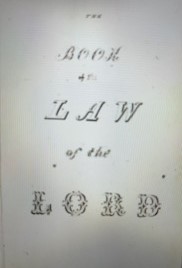
Recently I decided to do a deeper dive into the subject of the “Book”. I Googled it and found the actual recordings of donations of the Saints, as recorded in the Joseph Smith Papers (Josephsmithpapers.org). I spent an evening – two or three hours – reading entries in the Book. This proved to be an exciting and wonderful read. It was a real eye-opener! (And a tear-jerker, too!)
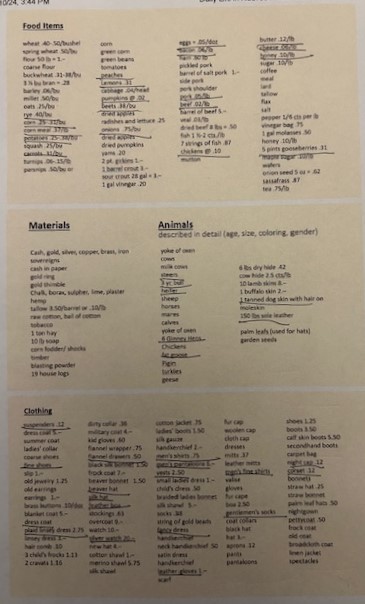
A Sister Ann Lewis used my same tactic – but she researched the original Book in Salt Lake City at the Church Historian’s Office. She was kind of overcome – as was I – as she read of the sacrifice of the Nauvoo Saints. She kept records of her findings and summarized them by kind in a blog article. Hers is a very fascinating record, and I highly recommend it for your information and sobering pondering. You can reach her record at
The Ann Lewis presentation is definitely a great read – as is the original source as noted above in the josephsmithpapers.org. Check them out.
I have included a couple of her pages – just for your edification.

I have also included here, just a couple of pages that I extracted from the real “Book of the Law” record. I was particularly interested in entries that mentioned my own ancestors.

Photo: Sample page from Book of the Law of the Lord
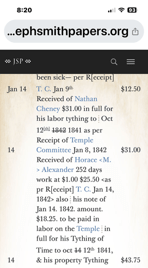
Photo: Nathan Cheney – 3rd Great Grandfather in The Book of the Law of the Lord

Photo: Horace Rawson – 3rd Great Grandfather in Book of the Law of the Lord
From my reading in the real “Book of the Law of the Lord”, I was “caught up in the Spirit” of it all and decided to pen a few lines about what I found – and my feelings for it:
THE BOOK OF THE LAW OF THE LORD
The “Book of the Law of the Lord”,
A book wherein all Saints should be.
The Book showed faith, their love of God,
Of Nauvoo Saints on bended knee.
A tithing book – for Temple too,
Giving all by consecration.
The Saints gave hearts, all they could do,
Sacrifice, their strong foundation.
Poor and driven, homes forsaken,
For God’s Kingdom, the Saints did live,
For though mobbed their faith unshaken,
Humbly, grateful, they came to give.
And lacking cash, “in kind” they gave,
Of what they grew, or what they raised.
They gave what little they did have,
And doing so, their God they praised.
Temple labor, one day in ten,
They worked together, they did build.
With brothers from their wards as when,
In turn, their duty to fulfill.
Some sacrificed, gave half their land,
Some even gave their iron plow.
Each person gave with open hand,
Willing to help that all might grow.
Women gave the quilts that they had made,
Or shirts to clothe the working men.
In faith and trust they often prayed,
For God’s protection of their men.
Men gave the products of their trade,
Loaned their horses and their wagon.
They gave to God the best they’d made,
The proved their salt, they were true men.
Some gave the savings of their life,
So willingly their all did share.
Together, husband and his wife,
No thought for any worldly care.
Some gave horses, saddles, harness,
A bag of flour, a bushel of corn.
A treasured watch, chest or mattress,
Hogs or chickens from the barn.
Some water pails, a skillet, lid,
A rolling pin, a looking glass,
Some wooden bowls, a feather bed,
Some beets, pumpkins, a big fat goose.
In their giving, Saints felt great joy,
Rejoiced that they could help and share,
Great blessings, they did all enjoy,
With trust, God gave His loving care.
God’s Prophet, Joseph, did impress,
His Saints to bring to Red Brick Store.
Their offerings, humble, but their best,
And we like them, can give as yore.
All consecrated to their God,
Gave to the clerks from faith within.
“The Book of the Law of the Lord”,
It’s a Book we want to be in.
Kevin V. Hunt – September 24, 2024
Yes, “The Book of the Law of the Lord” is really a special and sacred book. And like the Saints in Nauvoo, it’s a book we want to be in!
Hoping to be found recorded on the trail of the “Book of the Law of the Lord” … Hope to see you there, too!
Kevin V. Hunt
 On the Nauvoo Trail